
🔍 Read the full analysis: Pasta all'Amatriciana: Sweet Tomato, Crisp Guanciale, No Debate on Mad Tasting

Get kitchen staples and gadgets delivered free with Prime
- Fast, free delivery on millions of items
- Prime Video, Amazon Music and more included
- Member-only deals all year
TL;DR
A new cooking guide from Mad Tasting distills pasta all’Amatriciana to its four core ingredients — guanciale, tomatoes, Pecorino Romano and pasta — and argues that technique, not the onion-and-garlic debate, determines quality. The dish, tied to the Lazio town of Amatrice, takes about 40 minutes with one pan and one pasta pot.
A new cooking guide from Mad Tasting argues that pasta all’Amatriciana, one of Italy’s most argued-over sauces, comes down to exactly four ingredients — guanciale, tomatoes, Pecorino Romano and pasta — and that the long-running disputes over onion, garlic and other additions are optional garnish rather than essentials. The guide, built around the traditional sequence of render, simmer, marry, finish, says the dish takes about 40 minutes with one pan and one pasta pot, and that success depends on technique rather than allegiance to one camp or another.
Amatriciana is associated with Amatrice, a small hill town in Lazio on the border with Abruzzo, where shepherds historically carried cured pork jowl and aged sheep’s cheese into the mountains. The guide notes the dish is essentially gricia — a pasta of guanciale and cheese — with tomatoes added, a variation that developed after tomatoes became part of Italian cooking in the 1800s. That lineage explains where the flavor sits: the pork fat is the sauce’s backbone, the tomato is the counterweight, and the Pecorino provides the salty finish. Drop the tomato and the dish becomes gricia; drop the pork and it leans toward arrabbiata.
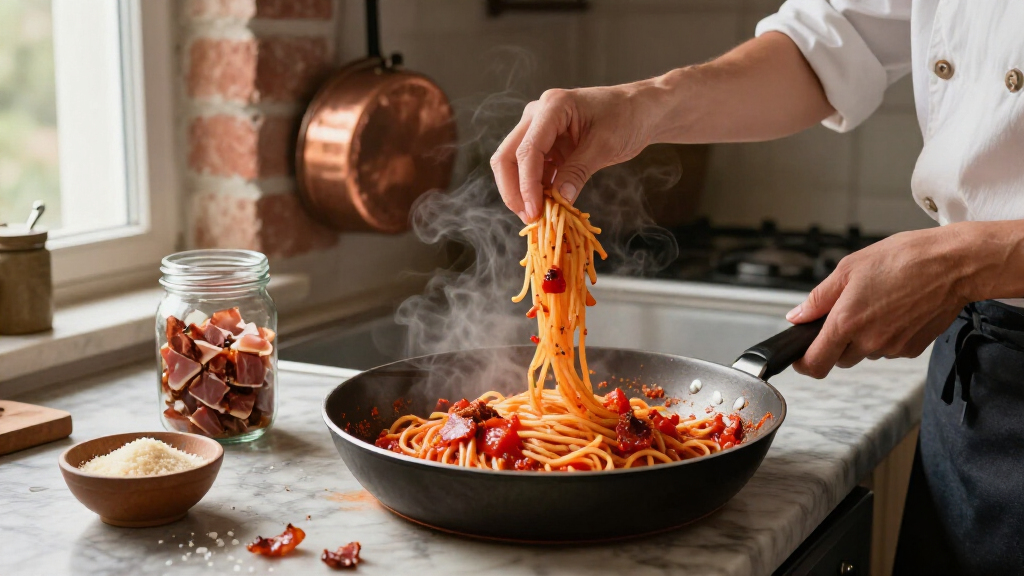
The technique section is specific. Guanciale should be cut into batons about ¼ inch wide — the thickness of a matchstick — and started in a cold pan over moderate heat. The guide warns that if the pan spits within two minutes, the cook is frying rather than rendering. After 8–10 minutes, a 150-gram piece should yield roughly two to three tablespoons of liquid fat; excess can be spooned off, but enough should stay in the pan to act, in the guide’s words, as the bridge between tomato and cheese. A pinch of chili blooms in the warm fat for thirty seconds before good-quality canned peeled tomatoes, crushed by hand, go in and simmer for 15–20 minutes until the raw taste disappears and the sauce tastes rounded and faintly sweet without any added sugar.
On the pork question, the guide is direct: guanciale (cured pork jowl) is the first choice for its rich, sweet-spiced flavor; pancetta is a reasonable substitute that changes the flavor modestly; smoked bacon is a last resort because the smoke dominates the tomato and cheese. On the onion-and-garlic debate, the guide reports observing two Roman cooks — one who treated onion as gospel and one who omitted it with equal conviction — and found both plates good. Local and household practice varies, it concludes, and claims of one universally authentic recipe are routinely overstated.
Why the Four-Ingredient Rule Matters
The guide’s value for home cooks is practical rather than academic. By fixing the core at four ingredients and labeling everything else negotiable, it shifts attention to the failures that actually ruin the dish: greasy pork floating in acidic tomato, and clotted cheese at the bottom of the pan. The piece addresses a real barrier too — guanciale can be hard to source — by ranking substitutes honestly instead of insisting on the traditional product. It also gives cooks permission to ignore authenticity policing without losing quality, since the shared goal of every worthwhile version, the guide argues, is a balanced sauce where the sweet, well-cooked tomato offsets salty pork and sharp cheese.
From Shepherds’ Gricia to Tomato Sauce
The pre-tomato ancestor of the dish, gricia, relied on the shepherds’ portable staples of the region: cured pork jowl and aged sheep’s cheese. Tomatoes entered Italian cooking broadly in the 1800s, and amatriciana emerged as gricia’s tomato variation. The town of Amatrice retains the dish’s name and identity, and the recipe’s structure still reflects its origins — the fat-rendering step is essentially the gricia method with tomatoes poured in afterward. The guide’s step-by-step follows that traditional order: render the pork, bloom the chili in the fat, simmer the tomatoes, and finish off the heat with cheese and starchy pasta water so the Pecorino melts without clumping.
“Amatriciana is, at its heart, a four-ingredient dish — guanciale, tomatoes, Pecorino Romano, and pasta. No cream. No garlic requirement. No onion obligation.”
— Mad Tasting guide
Where Local Practice Genuinely Differs
The guide itself concedes that parts of the recipe are unsettled. Whether onion or garlic belongs is a matter of household and neighborhood variation in Rome, and the piece presents both positions as valid rather than resolving them. Exact quantities — how much fat to leave in the pan, how long to simmer — are given as ranges and visual cues rather than fixed rules, and the guide encourages cooks to adjust after following the method once exactly. It does not claim any official body has certified a canonical recipe, and readers should treat its version as one well-reasoned interpretation of a dish with genuine regional variation.
From Following Once to Cooking Freely
The guide’s stated intention is that cooks follow the method exactly once, then adjust permanently to their own taste. Practical next steps for readers include sourcing guanciale or an accepted substitute, choosing between hand-crushed canned peeled tomatoes and passata, and deciding for themselves where they stand on the onion question. For food-safety and quality basics: keep guanciale refrigerated per the producer’s instructions, refrigerate any leftover sauce promptly and reheat to a full simmer, and note that the dish contains pork and dairy — common allergens for some diners are milk (Pecorino) and, for those avoiding sulfites, wine is not used in this version. No follow-up announcement from Mad Tasting is indicated; the piece stands as a reference guide.
Key Questions
Can I make amatriciana without guanciale?
Yes. The guide rates pancetta as a reasonable substitute that changes the flavor modestly. Smoked bacon is a last resort because the smoke noticeably overpowers the tomato and Pecorino.
Does authentic amatriciana contain onion or garlic?
According to the guide, no — neither is required. The four defining ingredients are guanciale, tomatoes, Pecorino Romano and pasta; onion and garlic are optional additions over which Roman cooks themselves disagree.
Why is my amatriciana sauce sharp or sour?
The guide attributes acidity to undercooked tomatoes. Simmering 15–20 minutes until the raw taste disappears produces a rounded, faintly sweet sauce — with no pinch of sugar needed.
How do I keep the Pecorino from clumping?
Finish the dish off the heat, adding the cheese gradually with starchy pasta water, which helps it melt smoothly instead of forming a clotted mass.
How long does amatriciana take to make?
About 40 minutes total, using one pan for the sauce and one pot for the pasta, according to the guide.
Source: Mad Tasting
NFL season / tailgating Picks
team gear
As an affiliate, we earn on qualifying purchases.