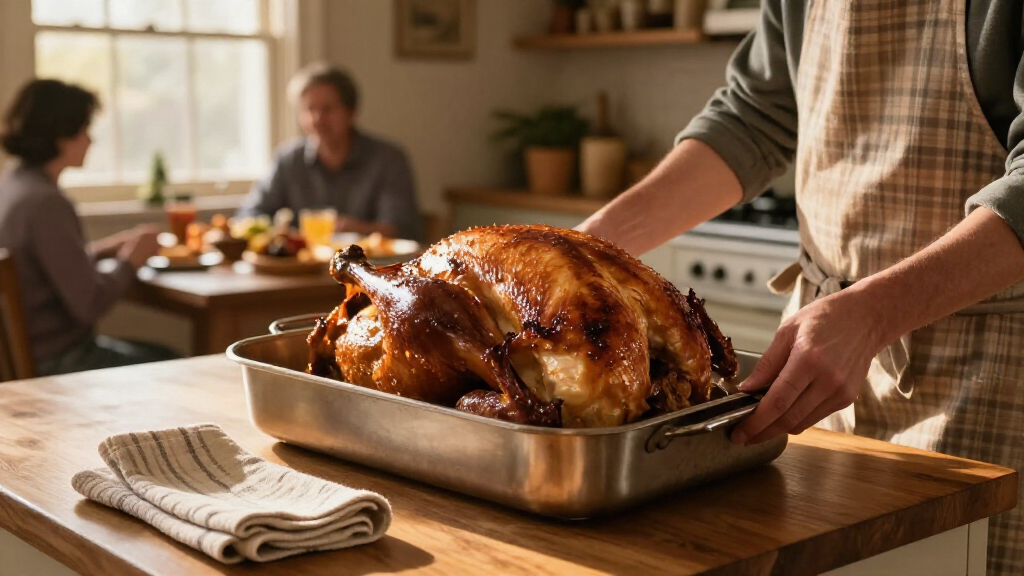
Use this guide to select a Thanksgiving roasting pan that fits your turkey and oven, set it up, and use it to roast the bird and collect its drippings. It is for home cooks with basic kitchen skills; allow 30-60 minutes to measure, prepare, and organize, plus the roasting time for your turkey. The guide covers pan size, rack choice, oven safety, and doneness checks.

Get kitchen staples and gadgets delivered free with Prime
- Fast, free delivery on millions of items
- Prime Video, Amazon Music and more included
- Member-only deals all year

Cuisinart Chef’s Classic 16-Inch Roasting Pan with Rack
- ✔ Dimensions: 20.7 × 12 × 4.9 inches
- ✔ Capacity: 731.14 cubic inches
- ✔ Weight: 7 pounds

Nonstick Turkey Roasting Pan with Rack – 17×13 Inch Extra Large Roaster
- ✔ Advertised size: 17 × 13 inches
- ✔ Listed dimensions: 15 × 8 × 3 inches
- ✔ Capacity: Up to 22 pounds

Glad Roasting Pan Nonstick 11×15 – Heavy Duty Metal Bakeware with Rack
- ✔ Dimensions: 15 × 10.3 × 2.8 inches, excluding handles
- ✔ Weight: 3.2 pounds
- ✔ Material: Carbon steel with nonstick coating
Difficulty: Beginner | Time: 30-60 minutes of preparation, plus the turkey’s roasting time
What You’ll Need
Tools & Materials:
- Measuring tape or ruler
- Roasting pan with sturdy handles
- Roasting rack, if the pan does not include one
- Instant-read or leave-in food thermometer
- Oven mitts
- Carving board and a tray for the turkey
Knowledge:
- Basic oven use
- How to read a food thermometer
Choose the turkey before the pan so you can check the bird’s dimensions and weight against the pan’s capacity. Thaw the turkey fully in the refrigerator, following food-safety guidance for its weight. Keep raw poultry and its juices away from ready-to-eat food.
Cuisinart Chef’s Classic 16-Inch Roasting Pan with Rack
For a Thanksgiving pan that can do more than carry a turkey through the oven, the Cuisinart Chef’s Classic is our strongest all-around choice. Its uncoated stainless steel construction avoids the care considerations of a nonstick surface, while the aluminum-encapsulated base is designed to distribute heat evenly. The removable rack elevates the roast for browning and lets drippings collect below. That combination makes it the most flexible of these three when we want one pan for turkey, other large roasts, and holiday sides.Compared with the Glad and 17×13-inch nonstick pans, Cuisinart has the highest stated oven limit at 500°F and is induction-compatible. That broader range gives it an edge for recipes that move from oven roasting to stovetop work. Its listed 16-inch pan is substantial, however, and its seven-pound weight is more than twice the Glad’s 3.2 pounds. The handles also become hot, so we need mitts for lifting. Buyers who mainly want effortless nonstick release may prefer either carbon steel alternative; this pick earns its place through construction and cooking flexibility, not the easiest cleanup.
Pros:
- Aluminum-encapsulated base supports more even heat distribution.
- Removable rack elevates food and allows drippings to collect below.
- Induction-compatible and oven-safe up to 500°F.
- Uncoated stainless steel construction suits repeat use across different roasts.
Cons:
- At seven pounds, it is heavier than the Glad pan and requires careful handling when full.
- Handles become hot during use and require oven mitts.
- Uncoated stainless steel does not offer the easy release of the nonstick alternatives.
Best for: Holiday cooks who want a substantial stainless steel roaster for turkey and other large meals, with a removable rack and stovetop compatibility.
Not ideal for: Buyers who prioritize nonstick release, lighter lifting, or a pan specifically sized for a small oven.
Bottom line: We recommend the Cuisinart for buyers who want the most versatile Thanksgiving roaster and can manage its weight and nonstick-free surface.
“We recommend the Cuisinart for buyers who want the most versatile Thanksgiving roaster and can manage its weight and nonstick-free surface.”
Nonstick Turkey Roasting Pan with Rack – 17×13 Inch Extra Large Roaster
When the centerpiece is a large turkey, this extra-large nonstick roaster puts capacity and food release ahead of all-purpose flexibility. Its aluminized carbon steel construction is intended to distribute heat evenly, and the U-shaped rack keeps meat raised above the bottom so drippings can collect underneath. The PTFE/PFOA-free coating is another practical advantage for cooks who want food to release more readily and cleanup to take less effort after a full holiday meal.Against the Cuisinart, this pan prioritizes nonstick convenience and a stated 22-pound capacity, while giving up the higher oven limit, induction compatibility, and stainless steel build. Its 450°F maximum is below the Cuisinart’s 500°F, and the listed dimensions are not a guarantee that it will fit every oven. The product description calls it 17×13 inches, while the supplied dimensions list 15 × 8 × 3 inches, so we should confirm the actual footprint before buying. Wide angled handles aid lifting, but they can become hot. Compared with the smaller Glad, this is the better fit for a larger bird if oven space allows; its size and handling demands make it less appealing for compact kitchens.
Pros:
- Listed 22-pound capacity targets larger Thanksgiving turkeys.
- PTFE/PFOA-free nonstick coating supports easier food release and cleanup.
- U-shaped rack lifts meat above the pan bottom.
- Wide angled handles are designed to assist with moving the pan.
Cons:
- Its extra-large format may not fit smaller ovens or be easy to maneuver.
- Handles can become hot during high-temperature roasting.
- The stated 450°F limit is lower than the Cuisinart’s, and it is not presented as stovetop-compatible.
Best for: Cooks preparing a large turkey who have enough oven clearance and want nonstick food release with an elevated rack.
Not ideal for: Small-oven owners, cooks seeking stovetop use, or anyone who needs confidently consistent dimensions before purchase.
Bottom line: We would choose this pan for a large turkey and easy cleanup, after confirming its actual dimensions against our oven.
“We would choose this pan for a large turkey and easy cleanup, after confirming its actual dimensions against our oven.”
Glad Roasting Pan Nonstick 11×15 – Heavy Duty Metal Bakeware with Rack
The Glad 11×15 roasting pan is the straightforward choice when we want a manageable nonstick pan for a turkey breast, chicken, beef roast, or vegetables rather than the biggest bird at the table. At 3.2 pounds, it is the lightest listed option, and its carbon steel body is described as heavy gauge and warp-resistant. The V-shaped metal rack promotes airflow around the roast, while the dishwasher-safe nonstick surface is intended to simplify the cleanup that follows a crowded Thanksgiving dinner.Compared with the larger 17×13-inch roaster, Glad trades the stated 22-pound capacity for a more compact footprint and lighter handling. Its rack is V-shaped rather than U-shaped, and both pans have a 450°F limit and are unsuitable for stovetop cooking. The Cuisinart is the more versatile choice for cooks who want induction use, a 500°F ceiling, and uncoated stainless steel; Glad is easier to justify when low-effort release matters more than those options. We should skip it for broiling, open-flame use, or recipes that require stovetop browning. It makes the most sense as an accessible holiday workhorse for smaller roasts, not as a universal turkey solution.
Pros:
- Lightest listed pan at 3.2 pounds, before adding food.
- Dishwasher-safe nonstick coating is intended to simplify cleanup and release.
- V-shaped rack lifts food for airflow during roasting.
- Carbon steel construction is described as heavy duty and warp-resistant.
Cons:
- Not suitable for stovetop, broiler, or open-flame use.
- Its 450°F maximum is lower than the Cuisinart’s 500°F limit.
- Less suited to large turkeys than the extra-large 17×13-inch option.
Best for: Cooks making a smaller turkey, chicken, or roast who want lighter handling and an easy-clean nonstick surface.
Not ideal for: Anyone needing a pan for a large turkey, stovetop use, broiling, or open-flame cooking.
Bottom line: We recommend Glad for smaller Thanksgiving roasts when easy cleanup and lighter handling matter more than maximum capacity or stovetop versatility.
“We recommend Glad for smaller Thanksgiving roasts when easy cleanup and lighter handling matter more than maximum capacity or stovetop versatility.”
As an Amazon Associate we earn from qualifying purchases.
Before You Start
Check the pan’s label or manufacturer instructions for its maximum oven temperature and whether it can go on the stovetop. A roasting pan must fit inside the oven with room for air to move and must be easy to lift when loaded. Do not rely on a disposable foil pan alone for a heavy turkey; set it on a sturdy rimmed baking sheet if its instructions permit, and test that the combined setup fits the oven.
Remove oven racks that are not needed, then position the rack so the turkey sits near the center of the oven. Leave enough space above the bird for the oven walls and heating elements. Plan for a helper if the loaded pan will be difficult to carry.
Step-by-Step Instructions
Step 1: Measure the turkey and oven
Measure the turkey’s approximate length and width, including the legs, and measure the oven’s usable interior width, depth, and height. Account for the handles and the rack position. The pan should hold the bird without forcing its sides against the pan walls, and it must slide into the oven without touching the door or oven sides.
Tip:Check the oven’s dimensions with the racks in the position you intend to use. A pan that fits only when tilted is too large for safe handling.
Check: You have written down the turkey dimensions and confirmed there is room for the pan and clearance around the bird.
Step 2: Choose a stable pan
Select a sturdy, oven-safe roasting pan with a flat bottom, raised sides, and handles that are securely attached. Choose a size that leaves a little room around the turkey for air circulation and for juices to collect. A rack helps lift the bird above the drippings; use a rack sized to sit flat inside the pan.
Tip:Heavy stainless steel or a heavy-gauge metal pan is generally durable. Check the manufacturer’s instructions before using nonstick cookware under a broiler or on a stovetop.
Check: The empty pan sits level, the rack does not wobble, and the handles feel secure.
Step 3: Check the pan’s capacity
Place the empty pan on the oven rack and slide it in and out to confirm a comfortable fit. Check that the door closes fully and that the pan does not touch the oven walls. If the pan is disposable or lightweight, set it on a sturdy support as directed by its manufacturer.
Tip:Do this check before adding the turkey. A full pan is heavier and more difficult to maneuver.
Check: The pan moves in and out level, and the oven door closes without contact.
Step 4: Prepare the turkey and pan
Remove the fully thawed turkey from its packaging, take out the neck and giblets if present, and pat the skin dry with paper towels. Season the turkey according to your recipe. Set the rack in the pan, then place the turkey breast-side up on the rack. Tuck the wing tips under the bird if your recipe directs.
Tip:Do not rinse raw turkey; splashes can spread bacteria around the sink and counter. Wash hands, utensils, and surfaces that touched raw poultry.
Check: The turkey rests securely on the rack, with no part of it hanging over the pan’s rim.
Step 5: Position the pan in the oven
Preheat the oven to the temperature specified by your recipe. Use oven mitts to place the pan on the prepared rack, centering it so it does not touch the oven walls. Close the door and keep the pan level as you slide it into place.
Tip:Do not add water to the pan unless your recipe calls for it. It can slow browning, and a pan filled with hot liquid is harder to handle.
Check: The oven door closes completely, the pan is level, and there is clearance around the turkey.
Step 6: Roast and monitor the turkey
Roast the turkey according to your recipe, using the time estimate as a guide rather than the final doneness test. If you baste, open the oven briefly and close it again promptly to limit heat loss. Avoid moving the hot pan unless necessary.
Tip:If the skin browns too quickly, tent the breast loosely with foil, taking care not to touch the oven’s heating elements. Follow your recipe’s guidance for any temperature adjustment.
Check: The turkey is browning as expected, and the oven temperature remains stable.
Step 7: Check the internal temperature
Near the end of the estimated roasting time, insert a food thermometer into the thickest part of the breast and the innermost part of the thigh, avoiding bone. Check the thickest part of the wing as well. Cook until each tested area reaches at least 165°F (74°C); return the turkey to the oven and check again if any area is below that temperature.
Tip:Do not judge doneness by skin color, clear juices, or the pop-up timer alone. Clean the thermometer probe after it touches undercooked poultry.
Check: The thermometer reads at least 165°F (74°C) in the breast, thigh, and wing.
Step 8: Rest the turkey and handle the drippings
Lift the turkey from the pan onto a clean carving board or tray using sturdy utensils, or ask a helper to steady the pan. Let it rest for the time specified by your recipe before carving. If making gravy, handle the drippings according to your recipe and the pan manufacturer’s stovetop guidance; strain them into a suitable container if the pan is not stovetop-safe.
Tip:Keep the hot pan on a heat-safe surface. Never pour hot drippings into a glass container unless it is rated for that use.
Check: The turkey rests securely away from raw-poultry surfaces, and the drippings are collected without spilling.
Common Mistakes to Avoid
- Choosing a pan based only on the turkey’s weight. — Measure the bird and the oven, including room for handles, rack placement, and safe lifting.
- Using a flimsy disposable pan to carry a heavy turkey. — Use a sturdy pan, or support disposable foil cookware on a rigid baking sheet as its manufacturer allows.
- Treating the estimated roasting time as proof that the turkey is done. — Check the breast, thigh, and wing with a food thermometer and cook each area to at least 165°F (74°C).
- Putting the hot roasting pan on an unprotected counter or using it on an unsuitable burner. — Set it on a heat-safe surface and check the manufacturer’s instructions before stovetop use.
Troubleshooting
Problem: The pan does not fit or the oven door will not close.
Solution: Remove the pan before adding the turkey and choose a smaller pan that still holds the bird securely. Adjust the oven rack if that creates clearance without bringing the turkey too close to a heating element.
Problem: The turkey browns before its interior reaches a safe temperature.
Solution: Loosely cover the browned areas with foil and continue roasting. Recheck the internal temperature in several places before removing the turkey.
Problem: The pan wobbles or bends while loaded.
Solution: Set it down carefully on a level, heat-safe surface. Ask for help moving it, and use a sturdier pan for future roasting; do not lift a loaded pan by one handle.
Problem: There is too little liquid or the drippings begin to scorch.
Solution: Check the pan without splashing hot fat. Follow your recipe’s instructions for adding liquid, and reduce the oven temperature only as the recipe directs. Do not pour liquid into a very hot pan abruptly.
What Success Looks Like
The pan fits level in the oven with the door closed and clearance around the turkey. The bird rests securely on the rack, cooks without the pan bending or spilling, and reaches at least 165°F (74°C) in the breast, thigh, and wing. After resting, the turkey is ready to carve and the drippings can be handled safely for gravy.
Next Steps
After the meal, let the pan cool until safe to handle, then discard or store drippings according to food-safety guidance. Wash the pan and rack as their care instructions direct; avoid abrasive cleaners on coated surfaces. Dry thoroughly before storing. Note the pan’s dimensions and how well it handled the turkey so you can choose the right setup next Thanksgiving.
Frequently Asked Questions
What size roasting pan do I need for a Thanksgiving turkey?
Choose a pan that holds the turkey without overhang, leaves some space around it, and fits inside your oven with the door closed. Measure both the bird and the oven; weight alone does not tell you whether a pan will fit.
Do I need a rack in the roasting pan?
A rack raises the turkey above the drippings and helps hot air circulate underneath. If you do not have one, follow your recipe’s setup instructions and make sure the turkey remains stable in the pan.
Can I use a disposable foil roasting pan?
Yes, if its manufacturer rates it for the oven and it fits your turkey. Because thin foil can flex, support it on a sturdy baking sheet when directed, and avoid carrying it alone while full of a heavy bird or hot liquid.
Can I put my roasting pan on the stovetop to make gravy?
Only if the manufacturer says the pan is safe for stovetop use and the burner supports it evenly. Otherwise, transfer the drippings to a suitable saucepan.
How do I know the turkey is cooked through?
Use a food thermometer in the thickest part of the breast and the innermost thigh and wing, avoiding bone. Each tested area must reach at least 165°F (74°C).