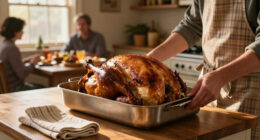
For Thanksgiving, the roasting pan has to do more than hold a turkey: it needs to fit the bird, collect drippings, withstand hours in the oven, and ideally help turn those drippings into gravy. The real choice is between a stainless steel roasting pan, which is built for browning and stovetop use, and a nonstick roasting pan, which makes food release and cleanup easier. Stainless steel is the better all-round investment for cooks who make gravy in the pan and want years of use; nonstick suits people who value simpler cleanup or roast foods that tend to stick. The difference matters most after the turkey comes out of the oven, when the pan either becomes a useful tool for gravy or a surface that is easier to wash.

Get kitchen staples and gadgets delivered free with Prime
- Fast, free delivery on millions of items
- Prime Video, Amazon Music and more included
- Member-only deals all year

Cuisinart Chef’s Classic 16-Inch Roasting Pan with Rack
- ✔ Dimensions: 20.7 × 12 × 4.9 inches
- ✔ Capacity: 731.14 cubic inches
- ✔ Weight: 7 pounds

Glad Roasting Pan Nonstick 11×15 – Heavy Duty Metal Bakeware with Rack
- ✔ Dimensions: 15 × 10.3 × 2.8 inches, excluding handles
- ✔ Weight: 3.2 pounds
- ✔ Material: Carbon steel with nonstick coating

Nonstick Turkey Roasting Pan with Rack – 17×13 Inch Extra Large Roaster
- ✔ Product title size: 17 × 13 inches
- ✔ Supplied dimensions: 15 × 8 × 3 inches
- ✔ Listed capacity: Up to 22 pounds
At a Glance
| Criteria | Stainless steel roasting pan | Nonstick roasting pan | Winner |
|---|---|---|---|
| Turkey roasting and browning | Handles high heat well; browning depends on pan construction and airflow | Can roast a turkey effectively; check the maker’s temperature limit | A |
| Gravy and stovetop use | Usually the better choice for deglazing and making gravy on the stovetop | Coating may limit stovetop use or high-heat deglazing; check the model instructions | A |
| Food release | Food can stick, especially sugary glazes or baked-on drippings | Usually releases food more easily | B |
| Cleanup | May need soaking and scrubbing | Typically quicker to wipe clean | B |
| Durability and care | Generally durable; avoid harsh scratching and follow care guidance | Coating can scratch or wear, so use suitable utensils and care | A |
| Value over time | Often costs more upfront, but can last for many holiday seasons | Worth paying for if easy release and cleanup matter more than longevity | Depends |
Cuisinart Chef’s Classic 16-Inch Roasting Pan with Rack
For cooks who want one Thanksgiving pan that can do more than roast a turkey, the Cuisinart Chef’s Classic is the most adaptable option here. Its uncoated stainless steel body and aluminum-encapsulated base are built for even heat distribution, and its 500°F oven rating gives it a wider temperature range than either nonstick alternative. It is also induction-compatible, a useful distinction if we want to use the pan on a compatible cooktop after roasting. The removable stainless steel rack raises the meat so drippings can collect below, supporting browning and easier separation from the pan surface.Compared with the Glad and the 17×13-inch nonstick model, this Cuisinart gives up the easy-release coating in exchange for higher heat tolerance and broader cooktop compatibility. That tradeoff matters at Thanksgiving: fond and browned drippings can be useful for gravy, but food may need more care to release cleanly, and cleanup may take more effort than with nonstick. At 7 pounds, it is also heavier than the listed Glad pan, so a full roast requires a firm two-handed lift. Its handles become hot in use, making oven mitts essential. This is our lead pick for households that value versatility and a sturdy stainless setup over the fastest cleanup.
Pros:
- Aluminum-encapsulated base is designed to distribute heat evenly.
- Removable rack elevates the roast for browning and drainage.
- Induction-compatible and oven-safe up to 500°F.
- Large 16-inch pan suits turkeys and family-size roasts.
Cons:
- Uncoated stainless steel can take more effort to clean than a nonstick pan.
- Handles become hot during use and require oven mitts.
- At 7 pounds, it is heavier than the Glad option before food is added.
Best for: Cooks who want a durable stainless roasting pan for a large holiday meal, induction use, and high-temperature oven cooking.
Not ideal for: Anyone prioritizing easy food release and the simplest cleanup, or seeking a lightweight pan to handle when full.
Bottom line: Choose the Cuisinart for the broadest cooking flexibility and high-heat range, provided stainless steel cleanup is acceptable.
“Choose the Cuisinart for the broadest cooking flexibility and high-heat range, provided stainless steel cleanup is acceptable.”
Glad Roasting Pan Nonstick 11×15 – Heavy Duty Metal Bakeware with Rack
The Glad roasting pan makes sense when we want a capable holiday roaster without signing up for stainless steel cleanup. Its nonstick coating is dishwasher-safe and designed for easy food release, while the V-shaped metal rack holds meat above the pan bottom. That shape offers a defined support point for a turkey or roast and leaves space for vegetables or drippings beneath. At 3.2 pounds, the pan itself is substantially lighter than the Cuisinart, an advantage when we’re moving other dishes around a crowded holiday kitchen.Against the larger 17×13-inch nonstick model, Glad’s listed dimensions are more compact, which may be a better fit for kitchens where oven clearance is uncertain. Its stated temperature ceiling of 464°F is also slightly above that model’s 450°F limit, though below Cuisinart’s 500°F. The compromise is method flexibility: Glad is not suitable for stovetop, broiler, or open-flame use, so we should plan to make gravy in separate cookware. The supplied dimensions exclude handles, which means we should allow extra room when checking oven fit. Choose it for a holiday roast and convenient cleanup; skip it if searing drippings in the pan is part of our routine.
Pros:
- Nonstick surface is dishwasher-safe and supports easier food release.
- V-shaped rack lifts the roast to promote airflow.
- Lighter listed weight than the Cuisinart pan.
- 464°F oven limit is higher than the 17×13-inch nonstick option’s stated limit.
Cons:
- Not suitable for stovetop, broiler, or open-flame use.
- Listed dimensions exclude handles, so the complete footprint needs checking.
- Nonstick coating limits the kind of high-heat use available with the Cuisinart.
Best for: Home cooks who want a lighter, dishwasher-safe nonstick roaster with a rack for a Thanksgiving bird or other roast.
Not ideal for: Cooks who need stovetop or broiler use, open-flame compatibility, or a pan for making gravy directly over a burner.
Bottom line: Pick Glad when easy cleanup and a lighter pan matter more than stovetop versatility or the largest stated capacity.
“Pick Glad when easy cleanup and a lighter pan matter more than stovetop versatility or the largest stated capacity.”
Nonstick Turkey Roasting Pan with Rack – 17×13 Inch Extra Large Roaster
When turkey size is the first question, this extra-large nonstick roaster stands out: its supplied details list a capacity of up to 22 pounds. The aluminized carbon steel construction is intended to distribute heat evenly, and the U-shaped rack lifts the bird away from the bottom so it can roast above collected drippings. Wide angled handles are designed to make a large pan easier to maneuver. For a household regularly preparing a substantial bird, that capacity focus gives this model a clearer role than Glad’s lighter, more compactly described roaster.Size also creates the central decision. The product title calls it 17×13 inches, while the supplied dimensions list 15 inches long by 8 inches wide by 3 inches high; those figures do not line up cleanly, so we should confirm the complete outside measurements before buying and compare them with our oven interior. The pan’s size may be a poor match for smaller ovens, and its handles can become hot during high-temperature roasting. Its 450°F limit is lower than Glad’s 464°F and Cuisinart’s 500°F, while the PTFE/PFOA-free nonstick coating emphasizes food release and cleanup rather than stovetop searing. This is the most capacity-oriented pick, but only if its real footprint fits our oven and the stated temperature range covers our recipes.
Pros:
- Listed capacity accommodates a turkey up to 22 pounds.
- U-shaped rack elevates meat above the pan bottom and drippings.
- PTFE/PFOA-free nonstick coating is designed for food release and cleanup.
- Wide angled handles are designed to help with maneuvering.
Cons:
- The large footprint may not fit smaller ovens.
- Handles can become hot during roasting.
- 450°F maximum is lower than the temperature limits of the other two picks.
- Supplied title and dimension details differ, so buyers should verify the full exterior size.
Best for: Cooks planning a large turkey who have a roomy oven and want a nonstick surface with an elevated U-shaped rack.
Not ideal for: Households with compact ovens, recipes requiring oven temperatures above 450°F, or cooks who want stainless steel and induction compatibility.
Bottom line: Choose this model for its stated large-turkey capacity only after confirming that its actual outside dimensions fit the oven.
“Choose this model for its stated large-turkey capacity only after confirming that its actual outside dimensions fit the oven.”
As an Amazon Associate we earn from qualifying purchases.
Key Differences
The biggest practical difference appears when the roasting is done. Stainless steel can take browned bits and drippings straight to the stovetop, where they can be loosened with stock or wine for gravy. That makes it a more capable cooking tool for a traditional Thanksgiving meal. Nonstick reduces the chance that skin, stuffing residue, or glaze will cling to the pan, but the coating can restrict stovetop use and requires care. Since coatings and temperature ratings vary, the manufacturer’s instructions matter more than the label alone.
Neither material guarantees a good roast by itself. Pan size, sturdy handles, rack design, and room for heat to circulate around the bird also matter. A heavy stainless pan can be costly, while a budget nonstick pan may be less durable; compare construction and dimensions before choosing. For a household that roasts once a year and wants washing to be painless, nonstick can be the sensible buy. For frequent roasting or pan gravy, stainless steel’s versatility usually justifies a higher initial price.
Detailed Comparison
Turkey roasting and browning (Stainless steel roasting pan wins — moderate)
Both materials can roast a Thanksgiving turkey, so the pan’s size, thickness, and rack matter more than the surface alone. Stainless steel handles high oven heat and works well for cooks who want to build flavorful browned drippings. Nonstick can make the bird easier to lift and reduce residue, though a coating’s heat limit should be checked before use. Stainless steel has a moderate advantage for cooks focused on browning; for a straightforward roast, the difference is minor.
Gravy and stovetop use (Stainless steel roasting pan wins — major)
Stainless steel wins by a major margin when gravy is part of the plan. It is generally suited to deglazing on the stovetop, letting cooks loosen browned bits and build flavor in the same pan. Some nonstick pans are not approved for burner use, and scraping browned residue from a coated surface can damage it. Check specific product instructions, but if pan gravy is central to the meal, stainless steel is the safer, more useful fit.
Food release (Nonstick roasting pan wins — moderate)
Nonstick has a moderate advantage for release. Turkey skin, sticky glaze, or baked-on sides are less likely to cling to its coated surface, which can help when lifting food and serving. Stainless steel is more prone to sticking, especially if the pan is not prepared well, although a rack reduces direct contact with the meat. The benefit matters most when the pan is also used for vegetables or glazed dishes.
Cleanup (Nonstick roasting pan wins — moderate)
Nonstick usually wins by a moderate margin because residue tends to come away with less effort. Stainless steel can need soaking and scrubbing after drippings bake onto the surface, particularly if gravy is not made in the pan first. Avoid abrasive tools on coated surfaces, and follow care guidance for either pan. For hosts who already face a sink full of dishes, easier cleanup can be a meaningful reason to choose nonstick.
Durability and care (Stainless steel roasting pan wins — moderate)
Stainless steel has a moderate long-term advantage: it has no coating to wear through, though it can discolor or scratch and still benefits from sensible care. Nonstick surfaces can be damaged by metal utensils, abrasive cleaning, and excessive heat, with the risk depending on the coating and construction. A carefully used nonstick pan can serve well, but stainless is generally the more forgiving choice for repeated seasonal use.
Value over time (moderate difference)
The value winner depends on how the pan will be used. Stainless steel can cost more at purchase, but its durability and stovetop versatility make that premium worthwhile for frequent cooks and gravy makers. Nonstick is better value for someone who roasts occasionally and prizes fast release and washing; paying extra for a premium stainless model may bring little benefit if it will see one use a year. Compare construction, included rack, and oven rating rather than relying on material alone.
Stainless steel roasting pan: Pros and Cons
Pros:
- Better suited to stovetop deglazing and pan gravy
- Durable surface with no coating to wear away
- Works well for cooks who want browned drippings
Cons:
- Food and drippings can stick
- Often takes more effort to clean
- Quality stainless models may cost more upfront
Nonstick roasting pan: Pros and Cons
Pros:
- Food generally releases more easily
- Often quicker to clean after roasting
- Can be a practical choice for occasional holiday use
Cons:
- Coating can scratch or wear with poor care
- Stovetop use and maximum heat depend on the specific pan
- Less suited to scraping browned bits for gravy
Who Should Choose What
Choose Stainless steel roasting pan if:
- You make gravy by deglazing the roasting pan on the stovetop.
- You roast often and want a pan without a coating to maintain.
- Browning and versatility matter more than the fastest cleanup.
Choose Nonstick roasting pan if:
- You want the turkey and sticky foods to release with less effort.
- You roast occasionally and prefer easier washing over stovetop versatility.
- You are willing to follow coating care and temperature limits for convenience.
Skip both if: Neither material fits if the available pans are too small for your turkey, have unstable handles, or lack a suitable oven rating. Choose a correctly sized, sturdy pan with a rack that supports the bird.
Value for Money
Paying more for stainless steel is worthwhile when the pan will earn its keep through pan gravy, frequent roasting, or years of holiday use. Its higher upfront cost buys versatility and a durable cooking surface, not guaranteed better turkey by itself. A nonstick pan can be the better value for occasional roasts if cleanup and release are the main frustrations. Before paying a premium for either, check the pan’s dimensions, construction, included rack, handles, and temperature guidance; those details shape usefulness as much as the material.
Final Verdict
Choose stainless steel for the best Thanksgiving all-rounder, especially if you make gravy from pan drippings or expect to roast regularly. Its stovetop capability and long service life make the added cost worthwhile for those cooks. Choose nonstick if easier release and less scrubbing matter more than deglazing, and the model’s oven rating suits your recipe. The deciding factor is what happens after roasting: cooks who turn the pan into gravy should buy stainless steel; cooks who want the simplest cleanup should buy nonstick.
Frequently Asked Questions
Is stainless steel or nonstick better for roasting a Thanksgiving turkey?
Both can roast a turkey well if the pan is large enough and rated for the required oven temperature. Stainless steel is the stronger choice if you want browned drippings and stovetop gravy; nonstick is more convenient for food release and cleanup.
Can I make gravy in a nonstick roasting pan?
Only if the manufacturer says the pan is safe for stovetop use. Even then, use utensils that will not scratch the coating and follow its heat limits. Stainless steel is usually the more straightforward pan for deglazing and gravy.
Is a more expensive stainless steel roasting pan worth it?
It can be, if you roast often or use the pan for gravy and other stovetop steps. For one annual turkey and a preference for easy washing, a well-made nonstick pan may deliver better value.
What should I check before buying a Thanksgiving roasting pan?
Check that the interior dimensions fit your turkey with some room around it, the handles are sturdy, and the pan and rack meet your oven’s temperature needs. Also confirm stovetop compatibility if you plan to make gravy in the pan.