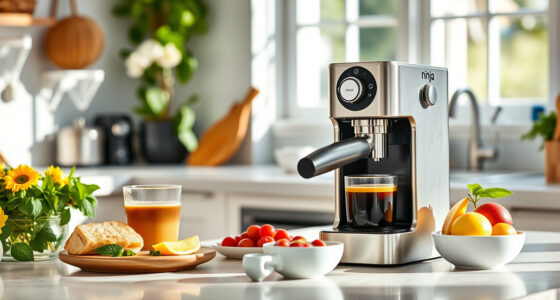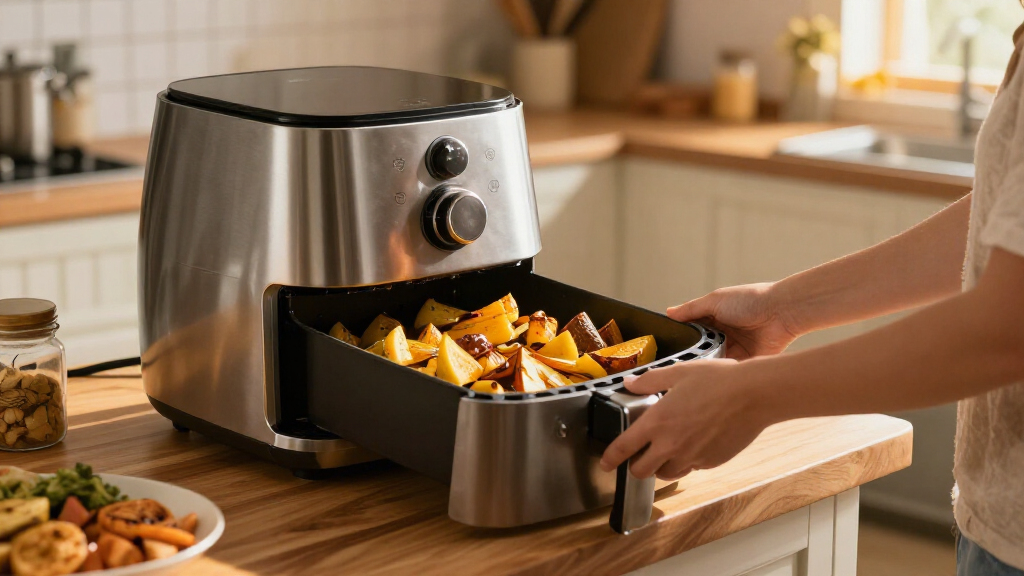
When shoppers look for an air fryer with large capacity, they are often choosing between two different ways to feed a group: cook separate foods at the same time, or make room for a larger single batch. A large-capacity dual-basket air fryer divides its advertised volume between two drawers, while an oven-style air fryer uses shelves or trays in one open chamber. That difference matters more than the headline quart or liter figure: two baskets can simplify a meal with different cook times, but one chamber can better accommodate a broad tray of vegetables, several slices of bread, or foods that do not fit neatly in drawers.

Get kitchen staples and gadgets delivered free with Prime
- Fast, free delivery on millions of items
- Prime Video, Amazon Music and more included
- Member-only deals all year

Chefman Air Fryer 9 Qt TurboFry 7-in-1
- ✔ Capacity: 9 quarts
- ✔ Functions: 7: air fry, broil, dehydrate, convection bake, reheat, keep warm, frozen foods
- ✔ Temperature range: 90°F–450°F

Ninja Air Fryer XL with MaxCrisp AF181
- ✔ Capacity: 6.5 quarts
- ✔ Functions: 6: Max Crisp, air fry, roast, bake, reheat, dehydrate
- ✔ Temperature range: 40°C–240°C (104°F–464°F per listed Celsius range; Max Crisp described as up to 450°F)

Chefman Air Fryer 8 Qt TurboFry 4-in-1
- ✔ Capacity: 8 quarts
- ✔ Functions: 4-in-1; presets for fries, chicken, meat and fish; also described as bake, dehydrate and frozen-food capable
- ✔ Temperature range: 200°F–400°F with 450°F Hi-Fry option
Neither design is best for every household. Choose the dual-basket style if you regularly prepare a main and side together and want separate temperature or timing controls. Choose oven-style if you value an open layout, want to cook across shelves, or plan to roast foods that need more horizontal room. Capacity labels are not directly comparable across brands, and usable space depends on basket shape, shelf spacing, and whether food can be arranged in a single layer. The guide below focuses on the practical tradeoffs behind those claims.
At a Glance
| Criteria | Large-capacity dual-basket air fryer | Large-capacity oven-style air fryer | Winner |
|---|---|---|---|
| Meal flexibility | Two independent baskets divide the load and keep foods separate | One chamber supports trays, shelves, and larger single batches | Depends |
| Usable space for bulky foods | Capacity is split; each drawer limits the size of individual items | Open layout can suit broad or tall foods, subject to shelf dimensions | B |
| Cooking separate foods together | Strong fit: separate controls can handle different foods and timings | Foods share the chamber and often need similar settings or timing | A |
| Crisping consistency | Usually straightforward in each basket, though crowded loads still need shaking | Multiple levels may brown unevenly and can need rotating | A |
| Countertop footprint | Often wide and deep to fit two side-by-side drawers | Often taller and may need clearance for the door and racks | Depends |
| Cleanup | Removable baskets are simple to wash, but there are two cooking vessels | Trays and racks may need more scrubbing; crumbs can collect inside | A |
| Value | Worth paying more for households that use both baskets often | Better value when open chamber space and accessories see regular use | Depends |
Chefman Air Fryer 9 Qt TurboFry 7-in-1
If the main goal is to fit a bigger batch in one appliance, the 9-quart TurboFry leads this group on listed capacity. Chefman says it can serve up to seven people; that figure is a useful guide, though meal size and food arrangement will determine how much fits comfortably. Compared with the Ninja’s 6.5-quart basket and the other Chefman’s 8-quart one, this model gives us the most room to work with.Its viewing window and shake reminder are practical on a heavily loaded basket: we can check progress without pulling the drawer out, and the reminder prompts us to redistribute food. Seven functions, including broil, dehydrate, frozen-food cooking and keep warm, also give it more range than the simpler 8-quart Chefman. The stated 450°F maximum and DC motor are aimed at crisping quickly, but the supplied claim of faster cooking is a manufacturer comparison, not a guarantee for every recipe.The tradeoff is footprint: at 15.75 inches deep, it is the deepest of these three, so measure the counter and clearance before choosing it. Its many functions may also be more than a buyer needs if they mainly make fries or reheated leftovers. We’d pick it for batch capacity and flexible controls; cooks with limited depth should compare the narrower Ninja first.
Pros:
- Largest listed capacity in this comparison at 9 quarts
- Viewing window and shake reminder help manage a full basket
- Seven cooking functions, including keep warm and frozen-food mode
- Basket and rack are listed as top-rack dishwasher safe
Cons:
- Deepest listed footprint here at 15.75 inches
- More functions and controls may feel unnecessary for basic air frying
- The faster-cooking statement is a manufacturer claim, not a universal outcome
Best for: Households that regularly cook generous batches and want multiple cooking modes plus a way to monitor food without opening the basket.
Not ideal for: Buyers with shallow counters, or anyone who wants a simple fryer for small portions and won’t use the extra programs.
Bottom line: Choose the 9-quart TurboFry when maximum listed basket space and added cooking options matter more than counter depth.
“Choose the 9-quart TurboFry when maximum listed basket space and added cooking options matter more than counter depth.”
Ninja Air Fryer XL with MaxCrisp AF181
The Ninja AF181 shows why capacity is more than the quart number. Its 6.5-quart basket is the smallest here, yet Ninja lists loads of up to 5 pounds of fries or 9 pounds of wings. Those examples make it a compelling option for specific party foods, although shape and arrangement still affect usable space. Against the 9-quart Chefman, we give up some stated volume; against both Chefman models, we get Max Crisp at up to 450°F and a comparatively narrow 11.3-inch width.Six functions cover the everyday jobs—air fry, roast, bake, reheat and dehydrate, with Max Crisp for frozen snacks and other foods that benefit from high heat. The removable crisper plate promotes airflow beneath food, and both it and the basket are dishwasher safe. Ninja also includes cooking charts and a recipe booklet, which may help new owners get started without adding another accessory purchase.The compromises are straightforward: it has less stated capacity than either Chefman and no viewing window or keep-warm mode in the supplied feature list. Its 14.92-inch depth also needs checking, even though it is narrower than the 9-quart model. Pick it when crisping, stated load examples and width matter more than maximizing basket volume; choose the 9-quart Chefman for larger mixed batches and broader controls.
Pros:
- Max Crisp mode reaches a stated 450°F
- Ninja lists capacity examples of 5 pounds of fries or 9 pounds of wings
- Narrower than the 9-quart Chefman at 11.3 inches wide
- Basket and crisper plate are dishwasher safe
Cons:
- Smallest listed basket at 6.5 quarts
- No viewing window or keep-warm function listed
- Still 14.92 inches deep, so counter clearance matters
Best for: Cooks who make wings, fries and frozen snacks, want a high-heat crisping mode, and have limited counter width.
Not ideal for: Households whose priority is the largest basket possible, or cooks who value a viewing window and keep-warm function.
Bottom line: Choose the AF181 if high-heat crisping and a narrow width outweigh the appeal of a larger quart capacity.
“Choose the AF181 if high-heat crisping and a narrow width outweigh the appeal of a larger quart capacity.”
Chefman Air Fryer 8 Qt TurboFry 4-in-1
The 8-quart TurboFry is the straightforward middle ground: it offers one quart more than the Ninja but gives up the 9-quart model’s extra room and seven-program setup. Four food presets—fries, chicken, meat and fish—make it easy to get cooking without sorting through a long menu. For buyers who want a sizable basket and familiar controls, this simpler layout may be an advantage.Chefman lists a 450°F Hi-Fry option, but the stated general temperature range is 200°F–400°F, so the upper setting is presented as a specific crisping option rather than the standard cooking ceiling. The basket and flat frying tray are top-rack dishwasher safe, and the shake reminder provides a useful nudge during a batch. Its 12.75-inch depth is the shortest listed here, which may make it easier to accommodate on a tight counter than the other two.There are limits to the value of its simplicity: only four presets and fewer named functions than either rival. It also lacks the 9-quart Chefman’s window and the Ninja’s dedicated Max Crisp branding. The product information lists 1,700 watts in its specs but also mentions 1,000 watts in one description line, so we would verify the unit details with the seller before buying. This model suits buyers who prioritize a generous basket and basic operation over extra cooking modes.
Pros:
- 8-quart capacity sits between the other two models
- Four food presets offer simple starting points
- Shortest listed depth at 12.75 inches
- Basket and tray are top-rack dishwasher safe
Cons:
- Four presets and fewer functions than the 9-quart Chefman or Ninja
- No viewing window listed
- Product description and specification disagree on wattage
Best for: Families seeking an 8-quart basket, simple food presets and a comparatively shallow listed footprint.
Not ideal for: Buyers who want the maximum capacity, the broadest cooking modes, or clearly consistent wattage information before purchase.
Bottom line: The 8-quart TurboFry is a sensible middle-capacity pick when simple presets and shorter depth matter more than maximum versatility.
“The 8-quart TurboFry is a sensible middle-capacity pick when simple presets and shorter depth matter more than maximum versatility.”
As an Amazon Associate we earn from qualifying purchases.
Key Differences
The largest practical distinction is how capacity is arranged. Two large drawers do not create one extra-large cooking surface: each has its own width and depth limit. That is helpful for keeping fries apart from chicken or cooking two portions to different timings, but it can rule out broad foods that would fit on a tray. An oven-style chamber is more adaptable for a single large item or foods spread across shelves, though shelf space and height still constrain what fits.
Cooking performance depends on the load and layout as much as the design. A basket tends to expose food to circulating air in a compact space, which supports even browning when the food is not packed tightly. An oven-style unit can handle several levels, but items on different shelves may cook at different rates and need rotation. For a busy household, the choice is usually between convenient parallel cooking and a more open chamber, rather than a simple capacity ranking.
There are ownership tradeoffs as well. Dual baskets tend to make routine washing simple, but there are two drawers to clean. Oven-style racks and trays offer more cooking arrangements, but corners and the chamber can take extra attention. Check the external dimensions and the size of the cooking surfaces before buying: a model that fits the counter but has narrow drawers or closely spaced shelves may not solve the capacity problem you have.
Detailed Comparison
Meal flexibility (moderate difference)
Winner: depends on the meal, with a moderate gap. Dual baskets keep foods separate and let each side use its own timing or temperature where the model supports independent controls. That is useful for a main dish and side that finish at different times. Oven-style models offer greater freedom to position trays or racks, which helps when foods need more width or height. For mixed dinners, A is usually easier; for varied shapes in one batch, B has the advantage.
Usable space for bulky foods (Large-capacity oven-style air fryer wins — moderate)
Winner: B, with a moderate gap. A dual-basket unit splits its capacity into separate drawers, so a roast or broad piece of food must fit inside one drawer even when the combined advertised volume looks generous. An oven-style chamber can offer a wider tray area and more flexible placement. Its usable dimensions still vary, so check the tray size and interior height for the foods you cook.
Cooking separate foods together (Large-capacity dual-basket air fryer wins — major)
Winner: A, with a major gap for households that cook full meals. Independent baskets are designed to handle two foods side by side, often with separate settings and a feature that coordinates finish times. An oven-style chamber can also hold different foods, but they share an environment and may need similar heat and timing. If you frequently pair a quick-cooking vegetable with a longer-cooking main, A reduces juggling.
Crisping consistency (Large-capacity dual-basket air fryer wins — minor)
Winner: A, by a minor to moderate margin. Each drawer has a relatively compact cooking area, and shaking or turning the food is usually simple. A full basket can still block airflow, so more capacity does not mean better results when food is piled up. Oven-style units can brown well, but cooking across several levels may produce uneven results unless trays are rotated. For large batches spread across shelves, expect more checking.
Countertop fit (moderate difference)
Winner: depends, with a moderate difference between models. Dual-basket units often need a broad footprint for side-by-side drawers. Oven-style units may take less width but stand taller, and their doors or trays need room to open. Measure the appliance location, include ventilation clearance, and check the door swing. The best fit depends on whether the kitchen has more free width or height.
Cleanup (Large-capacity dual-basket air fryer wins — minor)
Winner: A, with a minor to moderate gap. Removable baskets are generally easy to soak and wash, although cleaning two drawers takes more time than one. Oven-style racks and trays can have more corners, and grease or crumbs may collect inside the chamber. If the model includes dishwasher-safe parts, verify which parts qualify; that detail can change the everyday workload.
Value (moderate difference)
Winner: depends on use, with a moderate gap. A dual-basket model earns a higher price when both sides are used regularly to prepare different foods at once. If most meals use one basket or one type of food, paying for a second drawer may add little value. Oven-style models can justify their cost when the shelves, trays, and open chamber replace other cooking tasks. Compare included accessories and the usable dimensions, rather than paying extra for a larger capacity figure alone.
Large-capacity dual-basket air fryer: Pros and Cons
Pros:
- Cooks two foods separately at the same time
- Independent settings suit meals with different timings
- Compact drawers make shaking and routine washing manageable
Cons:
- Each drawer has its own size limit
- Side-by-side design can take substantial counter width
- Two baskets mean two vessels to wash
Large-capacity oven-style air fryer: Pros and Cons
Pros:
- Open chamber can fit broad or bulky foods
- Shelves and trays allow different arrangements
- Can handle several layers in one cooking session
Cons:
- Foods in the chamber may need similar settings
- Multiple levels can cook unevenly without rotation
- Racks and interior surfaces can take longer to clean
Who Should Choose What
Choose Large-capacity dual-basket air fryer if:
- You regularly cook a main and side at the same time and want them kept separate.
- Your meals include foods with different cook times or temperatures.
- You prefer removable drawers that are easy to access and wash.
Choose Large-capacity oven-style air fryer if:
- You want one open chamber for a broad tray, larger pieces, or flexible shelf placement.
- You often cook a large batch of one food and can rotate trays when needed.
- You will use the racks or trays for tasks such as roasting or reheating.
Skip both if: Skip both if your usual portions are small and a large appliance would crowd your counter; a compact air fryer or standard oven may fit your cooking better.
Value for Money
Pay more for a dual-basket model when simultaneous cooking solves a frequent problem: preparing separate foods with different timings can save hands-on coordination across many meals. The premium is harder to justify if one side will usually sit unused. Pay more for an oven-style model when you will use its chamber dimensions and included trays often, especially for broad foods that do not fit a drawer. A high advertised capacity alone is not a reason to spend more; compare the actual cooking surface, interior height, included accessories, and cleaning effort.
For value, match the design to the shape of your usual meals. A family that serves a main and side may get more daily usefulness from two baskets, while someone making large single batches may get more from one open chamber. If neither pattern is common, a less expensive, smaller model can be the better buy.
Final Verdict
For most households choosing a large-capacity air fryer to prepare complete meals, a dual-basket model is the stronger everyday choice because it cooks separate foods at once and makes timing easier. Choose an oven-style model if your priority is fitting broad or bulky foods in a single chamber, or if you will make regular use of its shelves and trays. The deciding factor is the shape of the food you cook: pick A for two separate portions with different needs, and B for one larger, more open cooking area. Before buying either, check the interior measurements against your usual cookware and counter space.
Frequently Asked Questions
Does a dual-basket air fryer have more usable capacity than an oven-style model?
Not necessarily. Its advertised capacity is split between two drawers, so a single bulky item must fit in one. An oven-style chamber may offer more continuous width or height, but tray dimensions and shelf spacing determine what actually fits.
Which style is better for a family?
A dual-basket model usually suits families that want to cook a main and side together or serve foods with different timings. An oven-style model may suit a family that makes one large batch or needs room for wider pieces of food. Match the design to your typical meal, not household size alone.
Do oven-style air fryers cook evenly on every shelf?
Often, shelf positions brown at different rates because airflow and distance from the heating element vary. Rotating trays or moving food between levels can help. For a single layer that needs little attention, a basket design is often simpler.
Is a more expensive large-capacity air fryer worth it?
It is worth paying more when the added layout solves a regular need: separate cooking in dual baskets or extra room and useful trays in an oven-style unit. If you mainly cook small portions, the larger model may take counter space without improving your routine.