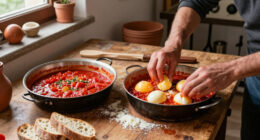
🔍 Read the full analysis: Sunday Timballo: The Showstopper Pasta Drum For December Tables on Mad Tasting

Get kitchen staples and gadgets delivered free with Prime
- Fast, free delivery on millions of items
- Prime Video, Amazon Music and more included
- Member-only deals all year
TL;DR
Sunday timballo is a home-style Italian baked pasta assembled in a mold, baked until browned, then rested before it is turned out and sliced. The source guide recommends a thick, cohesive filling, pasta cooked slightly short of al dente and enough resting time for the dish to hold its shape.
Mad Tasting’s guide to Sunday timballo sets out a practical way to serve molded Italian baked pasta as a December table centerpiece: pack pasta and a cohesive filling into a well-greased mold, bake it until browned, then rest the dish before unmolding. The guide presents a flexible home-style approach rather than a single official recipe, with moisture control and timing central to getting slices that hold together.
The dish is built from pasta and a substantial filling, either mixed together or arranged in layers inside a mold. A thick meat ragù with cheese is one option; roasted vegetables, vegetable ragù or well-drained greens can make a vegetarian version. Some household recipes also use cured meat or hard-boiled eggs. Mad Tasting’s guide describes these as variations, not required ingredients.
For a pasta-based version, Mad Tasting suggests short shapes such as rigatoni, ziti or penne, cooked slightly short of al dente because they continue softening in the oven. The guide says sauce should cling to the pasta instead of running freely, and vegetables should be roasted or sautéed until excess moisture has cooked away. It warns that a watery filling can leave the center loose and make wedges slump after unmolding.
Mad Tasting recommends a straight-sided mold with a stable base to help define the shape and offers a springform pan as a practical substitute. Its guide advises greasing the base, sides, corners and any seams carefully, then packing the filling gently without crushing it. Follow the chosen recipe’s oven temperature and timing, and allow the baked dish to rest before turning it onto a platter and cutting it.
A pasta centerpiece for December tables
Sunday timballo is molded Italian baked pasta, browned in the oven, rested, then turned out and sliced. Its shape depends on a cohesive filling and careful moisture control.
Build a filling that holds
Choose a thick filling that clings to the pasta instead of running freely.
Ragù and cheese
A substantial, cohesive filling for a home-style version.
Roasted vegetables
Vegetable ragù or well-drained greens can work; cook away excess moisture.
Adapt the assembly
Pasta, pastry and layered methods vary. Cured meat and hard-boiled eggs are optional.
Prepare for a firm slice
Rigatoni, ziti or penne continue softening in the oven.
Coat the base, sides, corners and seams. A springform pan is a practical substitute for a straight-sided mold.
Avoid crushing the filling. Rest the baked dish before turning it out and slicing.
Plan around the chosen recipe
The guide gives a flexible method, not a fixed formula.
- Cook sauce and vegetables until excess liquid is gone.
- Follow the recipe’s oven temperature and baking time.
- Leave time for resting before unmolding.
- Exact ingredients and assembly.
- Baking duration and resting time.
- Serving size and food-safety schedule.
Serve it as the centerpiece
A Centerpiece That Can Be Prepared Ahead
Mad Tasting’s guide presents timballo as a way to give a familiar baked-pasta meal a defined shape that can be brought to the table whole and sliced there. For a Sunday meal in December, that presentation can make one substantial dish the focus of the table, while reducing the need to serve several hot mains at once. The source describes this as a practical serving idea, not a claim that the dish is required or traditional for every December gathering.
The method also makes planning consequential: the filling needs to be thick enough to stay together, and the dish needs time to rest before serving. Mad Tasting says those steps affect whether the centerpiece can be sliced cleanly. It suggests pairing the dish with a sharp green salad and keeping portions modest, but does not provide nutritional information or a tested serving size.
Products Worth Considering

Ninja NeverDull 10-Piece German Stainless Steel Knife Set with Removable Sharpener, Black

Instant Pot Pro 6-Quart 10-in-1 Electric Pressure Cooker

KitchenAid 13-Cup Food Processor, KFP1318, Contour Silver
As an affiliate, we earn on qualifying purchases.
A Dish With Household Variations
Mad Tasting describes “Sunday timballo” as a home-style meal, not one standardized recipe. The name refers to a drum-shaped form, while ingredients and assembly vary among regions and households. The guide describes versions wrapped in pastry, lined with pasta or baked directly in a greased mold; these methods produce different textures and involve different preparation choices.
Mad Tasting says timballo has a broad resemblance to pasticcio and pasta al forno, while noting that names and techniques differ by place. The guide does not identify a particular regional origin or provide a historical timeline. Its focus is the practical approach: choose a filling that suits the household, control its moisture, and leave time for the dish to settle before serving.
Recipe Details Depend on the Cook
Mad Tasting’s guide does not give one complete recipe, a fixed ingredient list, oven temperature, baking duration or resting time. Those details depend on the particular version chosen, so cooks should follow a recipe’s specific instructions rather than treating the general method as a precise formula. The guide also does not establish that any one filling or mold is more authentic than the others.
For dietary planning, Mad Tasting flags wheat in most pasta and milk in cheese as common allergens; pastry may contain both. Ingredients in sauces and cured meats can vary, so labels should be checked and guests told what the dish contains. The source does not supply a food-safety temperature or storage schedule.
Plan the Bake Around Serving
For a December Sunday meal, Mad Tasting advises choosing the filling and mold first, then checking the recipe for its oven temperature and baking time. The guide recommends preparing the sauce or vegetables so excess liquid has cooked away, greasing the mold thoroughly, and cooking the pasta just short of al dente. Leave room in the schedule for the dish to rest before unmolding.
Mad Tasting suggests bringing the browned timballo to the table on a stable platter and slicing it after turning it out. A green salad can accompany the pasta, as the guide suggests. The exact bake, resting period and serving plan remain recipe-specific; the source offers no universal timing.
Key Questions
What is Sunday timballo?
Mad Tasting describes it as a home-style molded Italian baked pasta. Pasta and filling are baked in a mold, rested, then turned out and sliced.
What filling works best?
Mad Tasting recommends a cohesive, thick filling that clings to the pasta. Ragù and cheese are one option; well-drained vegetables can form a vegetarian version.
Why should the pasta be slightly undercooked?
It continues cooking in the oven. Mad Tasting recommends starting with pasta just short of al dente to help keep it from becoming mushy by serving time.
How do you help timballo hold its shape?
Mad Tasting advises greasing the mold thoroughly, avoiding excess liquid in the filling, packing the mixture gently, and letting it rest before unmolding. The source does not give a universal resting time.
What allergens may it contain?
Mad Tasting notes that wheat is common in pasta and pastry, and milk is common in cheese. Check labels for other ingredients and tell guests what the dish contains.
Source: Mad Tasting