
🔍 Read the full analysis: Risotto Alla Milanese: Saffron, Patience, And The Perfect Mantecatura on Mad Tasting

Get kitchen staples and gadgets delivered free with Prime
- Fast, free delivery on millions of items
- Prime Video, Amazon Music and more included
- Member-only deals all year
TL;DR
Risotto alla Milanese is Milan’s signature saffron rice dish built on short-grain rice, gradually added hot stock, and an off-the-heat butter-and-cheese emulsion. The dish contains no cream; its creaminess comes entirely from starch, technique, and about 18-20 minutes of attention.
The creaminess of Risotto alla Milanese comes from no cream at all — it comes from rice starch, cold butter, Parmigiano-Reggiano, and roughly twenty minutes of undivided attention, according to a detailed guide from Mad Tasting. The Milanese signature dish, a saffron-scented golden risotto, survives on technique rather than shortcuts, and the guide identifies rushing the stock, frantic stirring, and folding in cream as the errors that ruin most home versions.
The method, as described by Mad Tasting, is structured in four phases and takes about 18-20 minutes from the first addition of liquid. Short-grain rice — Carnaroli, Arborio, or Vialone Nano, the classic varieties of the Po Valley — is first toasted in butter (the tostatura), then cooked by gradually adding hot stock until the grains are tender with a firm center. The final step, the mantecatura, is an off-the-heat emulsion of cold butter and cheese that turns the dissolved starch glossy and flowing — a texture the Milanese call all’onda, or wave-like.
Rice selection matters, per the guide. Carnaroli is recommended for most home cooks because it releases starch generously while resisting overcooking. Arborio is the most widely available and affordable but softens fast, so timing is less forgiving. Vialone Nano, the Venetian variety, produces a looser, silkier result closer to the all’onda ideal. In all cases, the rice should never be rinsed: the dusty surface starch coating is, in the guide’s words, roughly half of the sauce. A practical serving measure is 80 grams (about 1/3 cup) of rice per person as a main course, with three to four times that volume in stock, plus extra kept warm.
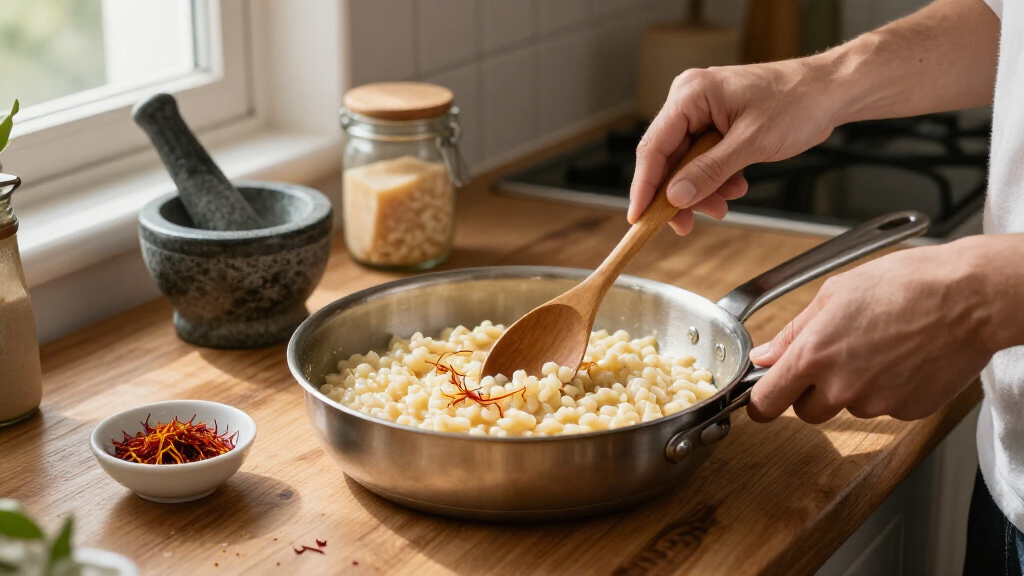
On saffron, the guide is specific: threads should be steeped in warm stock or water for 15-20 minutes before use so color and aroma distribute evenly, and the infusion should be added in the last few minutes of cooking so heat does not dissipate the aromatics. For a risotto serving four, the working range is roughly 0.3 to 0.5 grams of saffron threads. Too little yields what the guide calls ‘beige rice with a rumor of flavor’; too much turns the dish ‘medicinal and bitter.’ Turmeric, the common substitute, ‘gives you the yellow and none of the soul.’
Risotto alla Milanese: Saffron, Patience, and the Perfect Mantecatura
Milan’s signature golden rice dish contains no cream. Its creaminess comes entirely from short-grain rice starch, cold butter, Parmigiano-Reggiano, and roughly twenty minutes of undivided attention. The texture cannot be bought — only built.
Choose Your Rice, Keep the Starch
The short-grain varieties of the Po Valley were chosen precisely because their starch-rich surfaces dissolve into sauce while the grain core stays firm. Never rinse the rice — that dusty coating is roughly half of your sauce. Rice, as the guide puts it, “is not a precision instrument.”
Carnaroli
Releases starch generously while resisting overcooking. The most forgiving choice for most home cooks — the guide’s top pick.
Arborio
The most affordable and common variety, but it softens fast — timing is less forgiving and overcooking comes quickly.
Vialone Nano
Produces a looser, silkier result closest to the all’onda ideal — glossy, flowing, neither stiff nor soupy.
Four Phases, Twenty Minutes
The guide structures the cook in four phases, from the first toast of the rice to the off-heat emulsion. Hot stock is added gradually — never all at once — until grains are tender with a firm center.
Soffritto
5–7 min · medium-lowSweat finely diced onion in butter until translucent — no color allowed.
Tostatura
2–3 minToast the rice in butter until the grain edges turn translucent.
Stock, Gradually
~15 minAdd hot stock ladle by ladle until grains are tender with a firm center.
Mantecatura
Off the heatEmulsify cold butter and cheese into the starch — glossy and all’onda.
Saffron: Not a Garnish
Saffron is the dish’s identity. Steep threads in warm stock or water for 15–20 minutes before use, and add the infusion in the last few minutes of cooking so heat doesn’t dissipate the aromatics. For four servings: 0.3–0.5 grams — about two small pinches. Weigh it; don’t eyeball it.
“beige rice with a rumor of flavor”
0.3–0.5 g / 4 servings
“medicinal and bitter”
Turmeric, the common stand-in, “gives you the yellow and none of the soul.” Saffron’s floral, honeyed, faintly earthy flavor has no exact substitute.
The Errors That Ruin Most Home Versions
The guide’s central claim: the dish’s failures are technique failures, not ingredient failures. The texture cannot be bought — only built.
| Technique | Common Shortcut | Result | The Guide’s Verdict |
|---|---|---|---|
| Stock addition | All liquid at once | ✗ Grains break, starch never builds | Add hot stock gradually, ladle by ladle |
| Stirring | Frantic constant stirring | ✗ Broken grains, gluey paste | Steady, moderate agitation only |
| Creaminess | Folding in cream | ✗ Never traditional; masks the starch | Starch + butter + cheese + attention |
| Rice rinsing | Washing the grains | ✗ Half the sauce goes down the drain | “Like washing flour before baking” |
| Rice variety | Long-grain like basmati | ✗ Bred to stay separate and dry | Short-grain Po Valley rice only |
| Saffron timing | Added at the start | ~ Heat dissipates the aromatics | Infuse 15–20 min, add near the end |
| Mantecatura | Off-heat, cold butter | ✓ Glossy, flowing, all’onda | The defining final emulsion |
From the Guide
“That dusty coating on the grains is surface starch, and surface starch is roughly half of your sauce.”
— Mad Tasting“Turmeric, the common stand-in, gives you the yellow and none of the soul.”
— Mad Tasting“A plate of golden rice that has survived without changing its mind.”
— Mad TastingWhere the Guide’s Judgments Are Subjective
Some points are matters of taste rather than verifiable fact — rice rankings are recommendations, saffron potency varies by origin and freshness, and exact stock quantities can’t be fixed in advance because humidity, rice age, and the pan itself “shift the math.”
Answered
Does authentic Risotto alla Milanese contain cream?
No. Cream is never traditional — the creaminess comes entirely from rice starch, butter, Parmigiano-Reggiano, and the emulsifying mantecatura technique.
Which rice should I use?
Carnaroli for most home cooks — good starch release, resists overcooking. Arborio is more available but softer; Vialone Nano gives a looser, silkier texture.
How much saffron for four people?
Roughly 0.3–0.5 grams of threads — two small pinches. Steep 15–20 minutes in warm liquid; add the infusion near the end of cooking.
Why shouldn’t I rinse the rice?
Surface starch is a major part of the sauce. Rinsing removes it — which the guide compares to washing flour before baking.
What does “all’onda” mean?
It describes the finished risotto’s texture — glossy and flowing like a wave, neither stiff nor soupy — achieved through the final butter-and-cheese mantecatura off the heat. Traditionally paired with ossobuco alla Milanese, though most Milanese families eat it on its own as an ordinary weeknight meal.
Why Technique Beats Shortcuts Here
The guide’s central claim is that the dish’s failures are technique failures, not ingredient failures. Cooks who rush the stock, stir frantically, or add cream to fake the texture produce a noticeably inferior result — the texture cannot be bought, only built. Because the creaminess depends on starch release from specific rice varieties, substituting long-grain rice such as basmati, which is bred to stay separate and dry, produces the opposite of the intended result.
The dish also carries cultural weight: it is Milan’s signature rice preparation, traditionally paired with ossobuco alla Milanese (braised veal shank), though the guide notes most Milanese families eat it on its own as an ordinary weeknight meal. Saffron is described as the dish’s identity, not a garnish — its floral, honeyed, faintly earthy flavor has no exact substitute, and it is also a common allergen flag for sensitive diners, as is the dish’s dairy content (butter and Parmigiano-Reggiano).
Carnaroli short grain rice for risotto
As an affiliate, we earn on qualifying purchases.
As an affiliate, we earn on qualifying purchases.
Six Centuries of Golden Rice
According to Mad Tasting, the dish has remained essentially unchanged through six centuries of changing fashion and cuisine trends in Milan — ‘a plate of golden rice that has survived without changing its mind.’ Northern Italian cooking built its rice culture around the short-grain varieties of the Po Valley, chosen precisely because their starch-rich surfaces dissolve into a sauce while the grain core stays firm.
The finished dish should sit somewhere between stiff and soupy. The guide’s benchmarks: grains tender with a firm center after 18-20 minutes of cooking, hot stock added gradually rather than all at once, and a final texture that flows gently on the plate — all’onda — rather than holding a molded shape.
“There is a plate of golden rice in Milan that has survived six centuries of fashion, famine, and fusion cuisine without changing its mind.”
— Mad Tasting guide
Where the Guide’s Judgments Are Subjective
Several points in the guide are matters of taste or judgment rather than verifiable fact. The ranking of rice varieties — Carnaroli as ‘best’ for home cooks, Vialone Nano as closer to the ideal — is presented as recommendation, not measured result. The suggested saffron quantity (0.3-0.5 grams for four servings) is described as a ‘working range,’ and saffron potency varies by origin, freshness, and storage, so the effective amount may differ between kitchens.
The guide also states that exact stock quantities cannot be fixed in advance because humidity, rice age, and the pan itself ‘shift the math’ — meaning timing and liquid amounts remain approximate. The anecdote about over-saffroned risotto tasting like ‘a pharmacy’ is an illustrative story, not a tested threshold.
Applying the Method at Home
Cooks following the guide’s sequence would next put it into practice: sweat finely diced onion in butter over medium-low heat until translucent (about 5-7 minutes, no color), toast the rice in the butter for 2-3 minutes until edges turn translucent, then proceed through gradual stock additions and the off-heat mantecatura. The guide’s advice for first attempts is to keep extra stock warm, weigh the saffron rather than eyeballing it, and accept that the first effort may need timing adjustment — rice, as the guide puts it, ‘is not a precision instrument.’
Key Questions
Does authentic Risotto alla Milanese contain cream?
No. According to the Mad Tasting guide, cream is never traditional — the creaminess comes entirely from rice starch, butter, Parmigiano-Reggiano, and the emulsifying mantecatura technique.
Which rice should I use for Risotto alla Milanese?
Carnaroli is recommended for most home cooks because it releases starch well and resists overcooking. Arborio is more widely available but softens faster, and Vialone Nano produces a looser, silkier texture.
How much saffron does a four-person risotto need?
Roughly 0.3 to 0.5 grams of threads — about two small pinches. Steep them in warm liquid for 15-20 minutes beforehand, and add the infusion near the end of cooking.
Why shouldn’t I rinse the rice?
The surface starch on the grains is a major part of the sauce. Rinsing removes it, which the guide compares to washing flour before baking.
What does ‘all’onda’ mean?
It describes the finished risotto’s texture — glossy and flowing like a wave, neither stiff nor soupy — achieved through the final butter-and-cheese mantecatura off the heat.
Source: Mad Tasting
Fall Picks
fall essentials
As an affiliate, we earn on qualifying purchases.