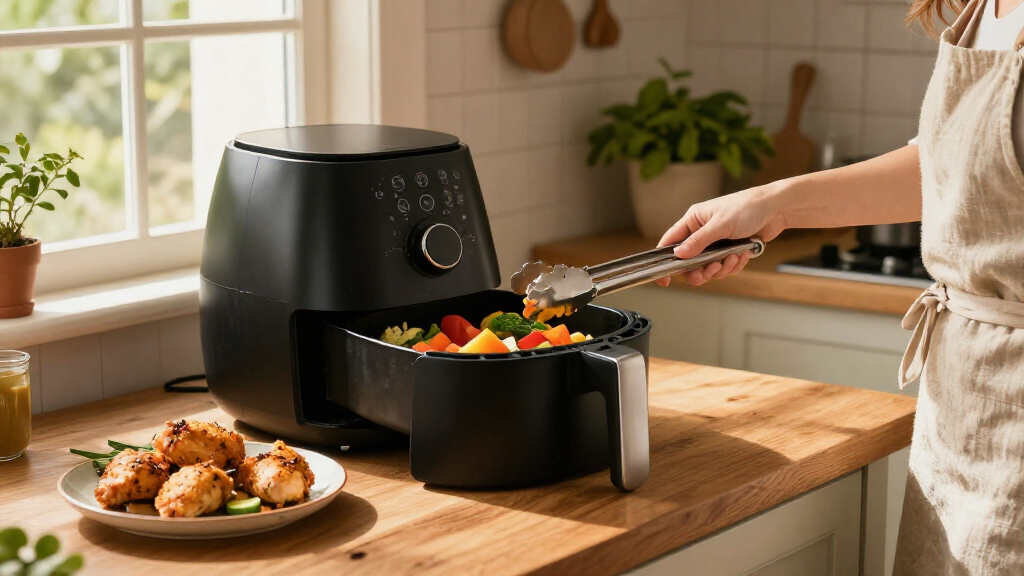
Use your air fryer to cook a balanced meal with vegetables and a protein, using little or no added oil and checking doneness with a food thermometer. This guide is for beginners who want practical, healthy air-fryer meals without relying on packaged snacks or guessing whether food is cooked through. Allow about 30-60 minutes for a meal, depending on the ingredients and your appliance. You will need an air fryer, basic kitchen tools, and a thermometer for checking meat or fish.

Get kitchen staples and gadgets delivered free with Prime
- Fast, free delivery on millions of items
- Prime Video, Amazon Music and more included
- Member-only deals all year

Cosori TurboBlaze Air Fryer, 6 Qt, 9-in-1, PFAS-Free Ceramic Coating
- ✔ Capacity: 6 qt / 5.7 L
- ✔ Power: 1,725 W
- ✔ Temperature range: 90°–450°F

bella Fits-anywhere Slim 4-Quart Air Fryer, Oatmilk
- ✔ Capacity: 4 quarts
- ✔ Basket capacity: Up to 3.3 lb of food
- ✔ Power: 1,300 W

Dash Compact Air Fryer, 2 Quart, Cool Grey
- ✔ Capacity: 2 quarts / 1.2 L
- ✔ Power: 1,650 W
- ✔ Temperature range: 85–200°C (about 185–392°F)
Difficulty: Beginner | Time: 30-60 minutes for a meal; timing varies by recipe
What You’ll Need
Tools & Materials:
- Air fryer with its basket or tray
- Food thermometer for meat, poultry, and fish
- Cutting board and sharp knife
- Measuring spoons
- Tongs or a heat-safe spatula
- Kitchen timer
Knowledge:
- Basic knife and food-handling skills
- How to use the air fryer’s temperature and timer controls
- How to read a food thermometer
Check your appliance manual for basket limits, preheating guidance, and cleaning instructions. Choose mostly whole or minimally processed ingredients, such as vegetables, beans, tofu, fish, or lean poultry. Air frying can reduce the amount of oil used compared with deep-frying, but the healthfulness of a meal also depends on ingredients, portions, salt, and cooking method.
Cosori TurboBlaze Air Fryer, 6 Qt, 9-in-1, PFAS-Free Ceramic Coating
The Cosori TurboBlaze is the most adaptable pick here for households that want to cook vegetables, proteins, and sides without splitting every meal into tiny batches. Its 6-quart square basket offers substantially more room than the bella’s 4-quart basket and three times the Dash’s 2-quart capacity. That can make it easier to prepare portions together, though basket dimensions and food arrangement still affect how evenly items cook.For healthy cooking, the PFAS-free ceramic coating gives buyers a clearly stated surface choice, and the 90–450°F range supports both lower-temperature tasks and high-heat crisping. The five-speed airflow system and 3600 rpm fan are designed to circulate heat quickly; these are useful capabilities, but they do not mean every food will cook evenly without attention to spacing and timing. Nine functions and customizable preheat settings add flexibility beyond the bella’s six presets, while dishwasher-safe components help keep cleanup manageable.The tradeoff is its footprint and heft. At 13.2 pounds, it is less convenient to move than the 7.3-pound bella or 5.8-pound Dash, and it needs about five inches of clearance behind and above for ventilation. Its 1,725-watt draw is also the highest listed here. This model makes the most sense when capacity and versatility matter more than easy storage; for a narrow counter, bella is the better compromise, and for one-person portions, Dash avoids buying more appliance than needed.
Pros:
- 6-quart square basket suits larger portions better than the 4-quart bella and 2-quart Dash.
- PFAS-free ceramic coating provides a clearly specified cooking surface.
- 90–450°F range and nine functions support more cooking approaches.
- Dishwasher-safe components and quiet operation under 53 dB simplify routine use.
Cons:
- Requires about five inches of clearance behind and above for ventilation.
- At 13.2 pounds, it is the heaviest and least convenient to store.
- Its 1,725-watt power draw is higher than the bella’s listed 1,300 watts.
Best for: Households that regularly prepare multi-portion meals and want a ceramic-coated basket, broad temperature range, and multiple cooking functions.
Not ideal for: People with very limited ventilation clearance, those who need a light appliance to put away after every use, or buyers who usually cook one small portion.
Bottom line: Choose the Cosori TurboBlaze when a roomy, versatile ceramic-coated air fryer matters more than compact storage.
“Choose the Cosori TurboBlaze when a roomy, versatile ceramic-coated air fryer matters more than compact storage.”
bella Fits-anywhere Slim 4-Quart Air Fryer, Oatmilk
The bella Fits-anywhere Slim earns its place by making a useful middle size easier to fit into a crowded kitchen. Its 4-quart capacity is more practical for everyday meals than the Dash’s 2-quart basket, yet its 8.22-inch width gives it a noticeably narrow profile. That is the main distinction from the larger Cosori: bella sacrifices capacity and some temperature range to occupy less side-to-side counter space.The basket holds up to 3.3 pounds of food, and the EverGood ceramic nonstick coating is described as free of PFAS, PFOA, PTFE, lead, and cadmium. Those details may appeal to shoppers prioritizing a specified coating; the Dash, by comparison, lists a PTFE interior. Six presets cover air frying, baking, roasting, broiling, reheating, and dehydrating, and the adjustable temperature range of 90–400°F provides flexibility for common tasks. Dishwasher-safe basket and crisping tray also make cleanup easier than with Dash’s hand-wash basket.There are limits to the slim approach. A four-quart basket may require batches when cooking for a larger household, and 400°F tops out below the Cosori’s 450°F ceiling. The exterior is plastic, which may not suit buyers seeking an all-metal appliance. Still, if the Cosori’s clearance needs and bulk are deal-breakers, bella gives us more meal capacity than the Dash while taking up less width than a conventional larger-format choice.
Pros:
- Narrow 8.22-inch width helps conserve counter space.
- 4-quart capacity is more flexible for meals than the Dash’s 2-quart basket.
- Ceramic coating is described as free of PFAS, PFOA, PTFE, lead, and cadmium.
- Basket and crisping tray are dishwasher safe.
Cons:
- Four quarts may still require batches for larger households.
- Maximum temperature of 400°F is lower than the Cosori’s 450°F.
- Plastic outer material may feel less substantial than a metal-bodied appliance.
Best for: Small-kitchen cooks who want more than snack-size capacity and prefer a ceramic coating with dishwasher-safe parts.
Not ideal for: Larger households that need to cook generous portions at once, or buyers who want a metal exterior or temperatures above 400°F.
Bottom line: Pick the bella Slim when we need a narrow footprint, practical mid-size capacity, and easy-clean ceramic-coated parts.
“Pick the bella Slim when we need a narrow footprint, practical mid-size capacity, and easy-clean ceramic-coated parts.”
Dash Compact Air Fryer, 2 Quart, Cool Grey
The Dash Compact has a clear job: air-fry small portions where a full-size machine would be awkward. At 2 quarts and 5.8 pounds, it takes up less room and is easier to move than either the bella or Cosori. For a student room, RV, or kitchen with very limited counter space, that can make cooking at home more convenient. Its adjustable temperature control and auto shut-off cover the basics, while the removable basket helps with transferring food.That compactness sets a firm ceiling on what it can do for healthy meal routines. The basket is half the size of bella’s and one-third the size of the Cosori’s, so cooking a full meal for several people means repeated batches. Dash advertises up to 75% less added fat than traditional frying, but that figure does not establish the nutrition of a particular meal; as with the other picks, results depend on ingredients and how much oil we add. Its stated temperature range is 85–200°C, approximately 185–392°F, below both the bella’s 400°F maximum and the Cosori’s 450°F.Material and cleanup are further compromises. The inner basket is listed as PTFE nonstick, while the Cosori and bella use ceramic coatings; buyers who prefer a specified PFAS-free ceramic surface may favor either of those alternatives. Dash’s basket also requires hand washing, unlike the dishwasher-safe parts on both competitors. Choose it for occasional portions and minimal storage demands, but skip it if cooking varied family meals or minimizing cleanup is the priority.
Pros:
- Small 2-quart body is easier to place in tight kitchens than the bella or Cosori.
- At 5.8 pounds, it is the lightest option in this lineup.
- Adjustable temperature and auto shut-off provide straightforward controls and a safety feature.
- Removable basket makes food transfer simple.
Cons:
- Small capacity means batch cooking for more than one or two people.
- PTFE nonstick interior differs from the ceramic coatings on the other picks.
- Basket requires hand washing, unlike both competitors’ dishwasher-safe parts.
Best for: Students, RV owners, and individuals who mainly cook snacks or single portions and need a lightweight appliance.
Not ideal for: Families, people who regularly cook complete meals in one batch, or buyers who want a ceramic-coated and dishwasher-safe basket.
Bottom line: Choose the Dash Compact for small portions and tight spaces, provided its limited capacity and hand-wash basket fit our routine.
“Choose the Dash Compact for small portions and tight spaces, provided its limited capacity and hand-wash basket fit our routine.”
As an Amazon Associate we earn from qualifying purchases.
Before You Start
Wash your hands, clean the air-fryer basket, and keep raw meat and its juices separate from ready-to-eat foods. Do not line the basket in a way that blocks airflow, and do not put loose parchment or foil in an operating appliance unless the manual permits it and food weighs it down. Use the appliance on a stable, heat-resistant surface with the manufacturer’s required clearance around vents. Cooking times vary by model and by food size, so use recipe times as a starting point, not proof of doneness.
Step-by-Step Instructions
Step 1: Plan a balanced meal
Choose a protein, a generous portion of vegetables, and an optional whole-grain or other filling side. For example, pair salmon or tofu with broccoli and serve with brown rice; or cook chicken breast with peppers and add beans or a whole-grain side. Favor fresh or frozen plain ingredients over breaded, heavily salted, or sweetened packaged foods. Decide which ingredients can cook together based on their required temperatures and timing.
Tip: If you are using frozen vegetables, check the package for added sauces or salt. You can cook plain frozen vegetables directly in many air fryers, though they may need extra time.
Check: Your meal includes a protein and vegetables, with an optional filling side, and the ingredients can be cooked safely.
Step 2: Prepare ingredients evenly
Cut vegetables and proteins into pieces of similar thickness so they cook at a similar rate. Pat wet ingredients dry with a clean paper towel when a browned surface is desired. Trim excess fat from meat if appropriate, and remove bones or packaging before cooking. Keep raw animal products on a separate board or clean the board and knife thoroughly before preparing vegetables.
Tip: Very thick pieces may brown outside before cooking through. Cut them thinner or finish them at a lower temperature after checking the surface.
Check: Pieces are a similar size, and raw-meat utensils have not touched food that will be eaten without further cooking.
Step 3: Season with a light hand
Use herbs, spices, citrus, garlic, or pepper for flavor, and measure any added salt rather than shaking it on freely. If using oil, toss the ingredients with a small measured amount—often a teaspoon or two for a batch—rather than pouring oil into the basket. Avoid aerosol sprays unless the appliance maker approves them; some sprays can damage nonstick coatings. Skip extra oil when the food already contains enough fat or does not need it to cook well.
Tip: Add sugary sauces near the end of cooking because they can darken or burn quickly in the circulating heat.
Check: Ingredients are lightly and evenly seasoned, with no pool of oil at the bottom of the bowl.
Step 4: Set the air fryer and arrange the food
Preheat only if your appliance manual or recipe calls for it. Set the temperature recommended by a reliable recipe for the specific food; avoid using one time and temperature for every ingredient. Place food in a single layer with space between pieces so hot air can circulate. Cook in batches if the basket is crowded, and keep foods with different cooking needs separate.
Tip: A packed basket can steam food instead of browning it. Leave space around pieces, but do not let small items fall through gaps in the tray.
Check: The appliance is set to the intended temperature, the food sits in a loose layer, and vents are unobstructed.
Step 5: Cook, turn, and check progress
Start the timer using the recipe’s suggested time as a guide. Halfway through, shake the basket or turn larger pieces with tongs if the food and appliance instructions allow it. Check progress before adding more time; air fryers can cook faster than expected, especially for small portions. If ingredients need different cooking times, remove finished items with clean utensils and continue cooking the rest.
Tip: Open the basket carefully because hot air and steam can escape. Keep your hands clear of the heating element and use heat-safe tools.
Check: Food is browning as intended without blackened edges, and pieces are cooking evenly rather than remaining pale on one side.
Step 6: Verify food safety and finish the meal
Check the thickest part of meat or fish with a clean food thermometer, avoiding bone and the basket. Cook poultry to 165°F (74°C); cook ground meats to 160°F (71°C); and cook fish to 145°F (63°C), following local food-safety guidance. Whole cuts of beef, pork, lamb, and veal should reach at least 145°F (63°C) and rest for three minutes. For vegetables and other foods without a specific temperature target, check that they are tender and cooked to your preference. Add any fresh herbs or suitable sauce after cooking, then serve promptly.
Tip: Color alone cannot confirm safe doneness. Clean the thermometer probe after checking raw or partly cooked food and before using it again.
Check: Foods that need a temperature check meet the recommended internal temperature, and vegetables are tender without being burned.
Step 7: Cool and clean the appliance
Turn off and unplug the air fryer, then let the basket and tray cool enough to handle safely. Remove crumbs and wash the removable parts according to the manual; do not immerse the appliance body or heating element. Dry all parts before reassembling. Refrigerate perishable leftovers within two hours, using shallow containers so they cool promptly.
Tip: Avoid abrasive pads or metal utensils on coated surfaces, which can damage the finish.
Check: The basket and tray are clean and dry, the appliance is off, and leftovers are stored safely.
Common Mistakes to Avoid
- Overfilling the basket to cook the whole meal at once. — Arrange food in a single layer with room for airflow. Cook in batches when needed; overcrowding often produces uneven, soft food.
- Adding oil by eye or using a heavy coating. — Measure a small amount and toss it with the ingredients. Air frying needs little oil, and extra oil can make food greasy or smoke.
- Assuming a fixed timer or browned surface means food is safe. — Check thick pieces with a food thermometer and extend cooking in short intervals if they have not reached a safe temperature.
- Using the same temperature and timing for every food. — Follow appliance-specific guidance or a reliable recipe, then check early because model performance and piece size vary.
Troubleshooting
Problem: Food is pale, soft, or unevenly cooked.
Solution: Remove some food to reduce crowding, turn or shake the remaining pieces, and continue cooking in short intervals. Dry wet ingredients before cooking if browning is the goal.
Problem: The outside is dark but the center is undercooked.
Solution: Lower the temperature and continue cooking until the center reaches a safe temperature. Next time, cut thick pieces more evenly or choose a lower temperature from the start.
Problem: The air fryer produces smoke or a burning smell.
Solution: Stop the appliance and unplug it if safe to do so. Let it cool, then remove accumulated grease and food debris. Avoid excess oil and sugary coatings, and check the manual before using liners or sprays.
Problem: Food sticks to the basket.
Solution: Let the basket cool, then release food gently with a heat-safe utensil. Use a light measured coating of oil if suitable for the food, and check the manual’s cleaning and coating-care advice.
What Success Looks Like
Your finished meal contains a protein and vegetables, uses only a modest amount of added oil, and is cooked evenly. Any meat or fish that requires a temperature check meets the appropriate safe internal temperature. The basket is not overcrowded, the food is not burned, and leftovers are cooled and stored safely. A healthy result does not depend on air frying alone: keep portions reasonable and limit excess salt, sugary sauces, and heavily processed ingredients.
Next Steps
Record the temperature, time, and basket load that worked well for your appliance, then adjust one variable at a time on future meals. Try other plain vegetables, beans, tofu, fish, or lean proteins, while checking each food’s recommended doneness. Wash the basket after each use and remove grease buildup as the manual directs. If you have a medical diet or food-safety question specific to your needs, follow advice from a qualified health professional or local food-safety authority.
Frequently Asked Questions
Does an air fryer make food healthy automatically?
No. It can cook with less added oil than deep-frying, but the ingredients, portions, salt, sauces, and overall meal still matter. Build meals around vegetables and minimally processed protein, and use packaged fried foods less often.
Do I need to add oil?
Not always. Many foods cook without added oil. A small measured amount can help some vegetables brown or prevent sticking, but avoid pouring oil into the basket and check that any spray is approved for your appliance.
Should I preheat an air fryer?
Follow your appliance manual or recipe. Some models and recipes call for preheating; others do not. If you skip preheating, the food may need a little more time, so check its progress and doneness rather than relying only on a timer.
Can I cook frozen vegetables in the air fryer?
Often, yes. Check the package and your appliance manual, cook in a loose layer, and shake or turn the vegetables during cooking if appropriate. Frozen vegetables can release moisture, so they may need more time to brown than fresh vegetables.
How do I know chicken is safely cooked?
Insert a clean food thermometer into the thickest part without touching bone. Chicken should reach 165°F (74°C). Do not rely on surface color or a recipe’s timing alone.