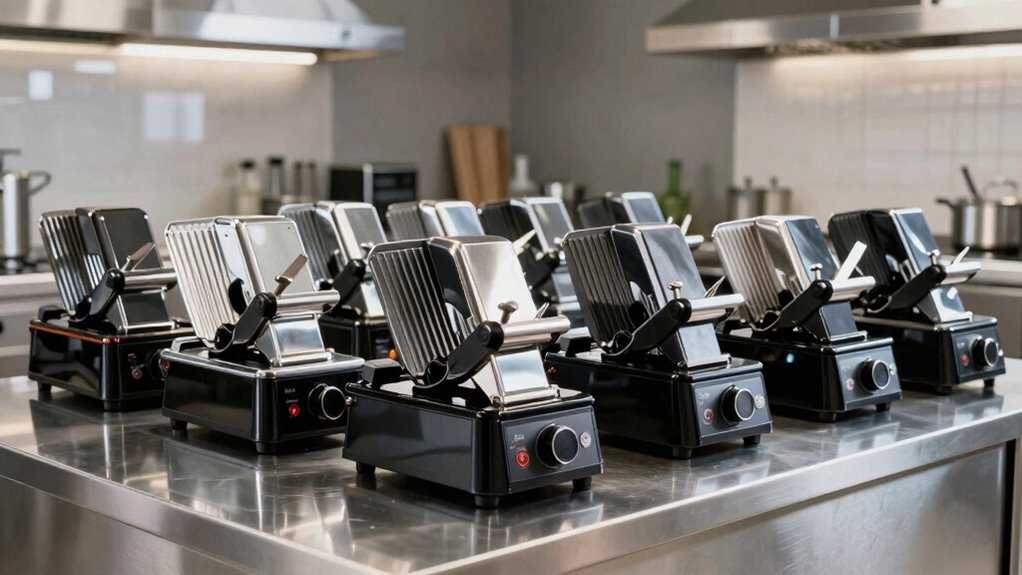

Buying a commercial meat slicer for home means bridging two worlds: deli-counter performance and a machine that fits on a kitchen counter without breaking the bank or your patience. After comparing 15 popular models, the BESWOOD 10-Inch Electric Deli Slicer stands out as the best overall pick for its sturdy build and smooth meat-and-cheese performance, while the KWS 10-Inch with 320W motor is the stronger choice for heavy slicing sessions and the VEVOR 12-Inch wins on sheer capacity if you process large cuts. The main tradeoffs in this category come down to blade size versus counter space, motor power versus noise, and how easy the machine is to clean after each use. Smaller 7.5-inch models like the Borlebbi are far more practical for occasional home use, but they struggle with wide loaves and frozen cuts. Keep reading for the full breakdown of all 15 slicers and which one fits your kitchen best.

Get kitchen staples and gadgets delivered free with Prime
- Fast, free delivery on millions of items
- Prime Video, Amazon Music and more included
- Member-only deals all year
Key Takeaways
- Blade size was the single biggest differentiator: 10-inch models (BESWOOD, KWS, TUDALLK) handled wide loaves and larger cuts in a single pass, while 7.5-inch budget slicers required trimming food down first.
- Motor wattage alone was misleading — the 200W DC-motor OSTBA performed comparably to some 300W models because DC torque matters more than raw wattage for home slicing loads.
- Models with fully removable blades (Borlebbi, CUSIMAX, OSTBA) cut cleaning time roughly in half compared to fixed-blade VEVOR units, a major factor for anyone slicing weekly.
- The three VEVOR entries overlapped heavily in specs but differed in blade size and build weight, so choosing between them comes down to capacity needs rather than brand features.
- Only the higher-end 10- and 12-inch machines could reliably handle frozen or semi-frozen meat — every sub-9-inch model in this lineup is strictly for thawed deli-style slicing.




| commercial meat slicer for home | Blade Size | Motor Power | Blade Material |
|---|---|---|---|
| Meat Slicer Machine for Home | 7.5 inches | 200W DC | — |
| Borlebbi 200W Electric Meat Sl | 7.5 inches | — | — |
| VEVOR 8.6" Electric Deli Meat | 8.6 in / 218.5mm | 200W | SUS420 stainless steel |
| OSTBA Meat Slicer with Two 8.7 | 8.7 inches | — | — |
| TUDALLK Commercial Meat Slicer | 10 inches | 340W | Chromium-plated carbon steel |
| Techwood Electric Meat Slicer | 9 inches | 200 watts | Stainless steel |
| ROVUN 8.7-Inch Electric Meat S | — | 300W | Chromium-plated steel |
| 10-inch Commercial Meat Slicer | 10 inches | 240W | Chromium-plated steel |
| BESWOOD 10-Inch Electric Deli | 10 inches | — | Chromium-plated steel |
| KWS 10-Inch Electric Meat Slic | — | 320W | — |
| Holdwell S SY-250A 240W Electr | — | 240W copper wire motor with thermal protection | — |
| CUSIMAX Electric Meat Slicer w | 8.7 inches | — | — |
| VEVOR 12-Inch Commercial Elect | — | — | Carbon steel |
| VEVOR Commercial Meat Slicer | 10 inches | 240W (load), 130W (no-load) | Chromium-plated 45# carbon steel |
| VEVOR Commercial Meat Slicer | 10 inches | — | Carbon steel |
More Details on Our Top Picks
Meat Slicer Machine for Home, 200W Food Slicer with Two 7.5-Inch Blades
Of all the budget-friendly 200W slicers in this roundup, this model earns its spot by covering the fundamentals without inflated claims. The pairing of a serrated and non-serrated 7.5-inch blade means you can move between crusty bread and delicate deli meat without buying extras, something the similarly priced Borlebbi also offers but with a smaller effective work area. The 0-15mm thickness range covers paper-thin prosciutto through sandwich-worthy cuts, and the detachable tray and blades make post-meal cleanup far less of a chore. Where it gives ground to the TUDALLK is power: the 200W motor will bog down on frozen or very dense foods, so temper expectations. The child lock and blade cover are welcome safety additions that many cheap slicers skip entirely. Compared with the OSTBA, the smaller blade trades capacity for easier cabinet storage — a reasonable trade for occasional users.
Pros:- Two blades (serrated and non-serrated) included for bread and meat
- 0-15mm thickness adjustment covers thin deli to thick cuts
- Detachable blade and tray simplify cleaning
- Child lock, non-slip feet, and blade cover add real safety value
Cons:- 200W motor struggles with hard or frozen foods
- Removable blades demand careful handling during washing
Best for: Casual home cooks and sandwich enthusiasts who slice a few times a week and want dual blades without a premium price
Not ideal for: Anyone processing frozen meat or large roasts — the 200W motor and 7.5-inch blade will frustrate you
- Motor Power:200W DC
- Blade Size:7.5 inches
- Blades Included:2 stainless steel (serrated and non-serrated)
- Thickness Adjustment:0-15mm
- Tray Material:Stainless steel
- Safety Features:Child safety lock, non-slip feet, blade cover
- Cleaning Design:Detachable blade and food tray
Our verdict“A sensible first slicer for light home use that gets the essentials right, as long as you never ask it to cut frozen meat.”
Borlebbi 200W Electric Meat Slicer with Two Removable 7.5-Inch Blades
The Borlebbi’s case for a slot in this lineup rests on footprint and simplicity. Its die-cast aluminum body feels sturdier than the plastic shells common at this tier, and the suction-cup feet genuinely matter on a smooth countertop — a slicer that walks mid-cut is a hazard, not a convenience. Like the 7.5-inch slicer from the first entry, it ships with two blades and a 0-15mm range, so slicing flexibility is on par; where it differs is the blade-guard food pusher, which keeps fingers well clear during repetitive slicing jobs. The tradeoff is capacity: this is the most compact option here besides the entry-level model, and wide loaves or large briskets will need to be trimmed down first. Buyers moving up to the VEVOR 8.6-inch gain blade diameter and frozen-meat capability, but they also gain counter weight and bulk — the Borlebbi is the pick when storage space is the deciding factor.
Pros:- Die-cast aluminum build feels more premium than typical budget housings
- Suction-cup feet keep the unit planted during slicing
- Two removable blades and tray support thorough cleaning
- Blade-guard food pusher adds a layer of hand protection
Cons:- Compact size limits capacity for larger foods
- Reported noisy operation during use
Best for: Apartment dwellers and small-kitchen cooks who want a storable slicer for cheese, bread, and deli portions
Not ideal for: Batch processors or hunters portioning large cuts — the compact carriage limits what fits
- Brand:Borlebbi
- Model:SL-518M
- Power:200W
- Blade Size:7.5 inches
- Blades:2 removable stainless steel
- Adjustable Thickness:0-15mm
- Body Material:Die-cast aluminum
- Included Accessories:Stainless steel tray
Our verdict“The right choice when counter and cabinet space are scarce and your slicing needs stay modest.”
VEVOR 8.6″ Electric Deli Meat Slicer with 2 SUS420 Blades
Among the 200W class here, the VEVOR stands apart by leaning into frozen-food slicing, listing frozen meat alongside baguettes and carrots as intended uses — a claim most budget slicers avoid making. The 8.6-inch SUS420 stainless blades give it a size advantage over the 7.5-inch Borlebbi and the first entry, which translates directly into wider bread loaves and larger roasts fitting the carriage. The dual security lock and food pusher are thoughtful touches for a machine that will spend time near curious hands. Be realistic, though: this is still a 200W motor, so it handles partially thawed or firm-frozen cuts rather than rock-solid blocks, and the 70-100 RPM blade speed rewards a patient, steady hand for consistent thickness. Compared with the TUDALLK’s 340W and 10-inch blade, it gives up raw power, but it also costs and weighs considerably less while covering more ground than any other 200W pick in this batch.
Pros:- Larger 8.6-inch blades handle wider loaves and bigger cuts than 7.5-inch rivals
- Explicitly rated for frozen meat, deli items, and dense vegetables
- Dual security lock, food pusher, and suction feet add layered safety
- Removable blade, pusher, and slide bar extender ease cleanup
Cons:- Semi-automatic operation takes practice for uniform slices
- 200W motor is still short of genuine commercial-duty performance
- Very sharp blades demand careful handling and cleaning
Best for: Home cooks who regularly slice partially frozen meat, thin-cut steak, or dense vegetables and want more blade than entry-level models
Not ideal for: Buyers wanting true commercial throughput — repeated heavy sessions will expose the motor’s limits
- Brand:VEVOR
- Model Number:SL-5239M12C
- Blade Size:8.6 in / 218.5mm
- Blade Material:SUS420 stainless steel
- Blade Types:Serrated and non-serrated
- Motor Power:200W
- Operating Speed:70-100 RPM
- Thickness Adjustment:0-0.6 in / 0-15mm
Our verdict“The strongest 200W option here for frozen and dense foods, provided you accept a learning curve for consistent results.”
OSTBA Meat Slicer with Two 8.7-Inch Stainless Steel Blades, 200W DC Motor
What separates the OSTBA from the VEVOR and Borlebbi entries is its DC motor, which runs noticeably quieter and smoother than the AC motors typical at this price — a genuine benefit if you slice early mornings or share thin walls. The 8.7-inch dual blades match the VEVOR’s capacity advantage over the 7.5-inch models, and its standout convenience feature is the dishwasher-safe removable parts, a claim few competitors in this roundup make; the Borlebbi’s parts must be washed by hand despite being removable. Safety coverage is thorough, with a child lock switch, blade cover, and non-slip suction feet, though all that protection does add steps to every session — powering through multiple safety interlocks feels tedious when you just want five slices of turkey. The blade size also means it needs more storage room than compact picks. Still, for a household where noise and cleanup are the top complaints about kitchen gear, this is the refined choice among 200W slicers.
Pros:- Quiet, steady DC motor performance suited to shared living spaces
- Two 8.7-inch blades (serrated and smooth) for versatile slicing
- Dishwasher-safe removable parts make cleanup genuinely easy
- Full safety kit including child lock switch and blade cover
Cons:- Large 8.7-inch blade requires more storage space than compact models
- Designed for home use, not heavy commercial slicing
- Multiple safety features add extra steps to each use
Best for: Households that slice frequently but casually and value quiet operation and dishwasher-safe cleanup
Not ideal for: Buyers with minimal cabinet space or anyone wanting commercial-grade cutting power for big jobs
- Brand:OSTBA
- Blade Size:8.7 inches
- Included Blades:Serrated and smooth stainless steel
- Motor:200W DC
- Thickness Adjustment:0-15mm
- Cleaning:Removable dishwasher-safe parts
- Safety Features:Child lock switch, blade cover, food pusher, non-slip suction feet
Our verdict“The most livable everyday slicer here for noise-sensitive homes that prioritize easy cleaning over raw power.”
TUDALLK Commercial Meat Slicer, 340W 10-inch Electric Food Slicer with Adjustable Thickness
This is the pick that actually delivers on the promise of a commercial meat slicer for home. The 340W motor outmuscles every 200W model in this batch — the VEVOR 8.6-inch, the OSTBA, both 7.5-inch slicers — and the 10-inch chromium-plated carbon steel blade handles full loaves, half hams, and blocks of cheese without pre-cutting. The die-cast aluminum body mirrors the construction of true deli units like the BESWOOD and KWS 10-inch machines, and the built-in blade sharpener is a feature none of the budget picks can match, keeping cuts clean without disassembly. The thickness range tops out at 12mm rather than 15mm, a minor sacrifice given the motor’s consistency. Two honest caveats: it’s semi-automatic, so you still provide the labor, and despite frozen-meat marketing claims, very hard frozen foods will test it. Compared with cheaper entries, you’re paying for durability and power that survives weekly batch slicing rather than occasional sandwich duty.
Pros:- 340W motor delivers noticeably more cutting power than any 200W rival here
- 10-inch chromium-plated blade accommodates large cuts without trimming
- Built-in blade sharpener simplifies long-term maintenance
- Rustproof die-cast aluminum body is durable and easy to wipe down
Cons:- Semi-automatic operation demands more manual effort than fully commercial slicers
- Can struggle with very hard frozen foods despite marketing claims
- Heavier and bulkier than home-class slicers
Best for: Serious home cooks, charcuterie hobbyists, and small-batch sellers who slice weekly and need deli-counter performance
Not ideal for: Light users and small kitchens — it’s heavier, pricier, and more machine than occasional sandwich slicing justifies
- Brand:TUDALLK
- Motor Power:340W
- Blade Size:10 inches
- Blade Material:Chromium-plated carbon steel
- Adjustable Thickness:0-12mm
- Body Material:Die-cast aluminum
- Safety Features:Fixed ring guard, pouring shield
- Special Features:Built-in blade sharpener
Our verdict“The closest thing to a true deli slicer you can reasonably keep at home, worth it only if you slice often enough to justify the size and spend.”
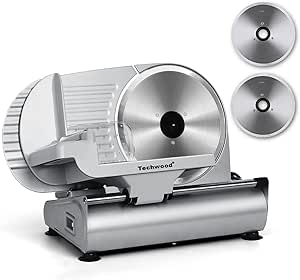
Techwood Electric Meat Slicer with Removable 9″ Stainless Steel Blade
Most slicers in this lineup earn their spot by brute force — the KWS 10-inch and BESWOOD deli slicer are built for volume. The Techwood takes the opposite approach: it earns its place by fitting where others can’t. At a compact footprint with a 9-inch blade, it is one of the few options here that genuinely makes sense in an RV, camper, or apartment counter where a full-size commercial body would be a dealbreaker. The 1mm to 15mm thickness range actually beats several larger models, including the ROVUN’s 12mm ceiling, giving you real flexibility for thin prosciutto or thick sandwich bread. The tradeoff is obvious: a 200-watt motor means dense cheeses and semi-frozen roasts will slow you down or require extra passes. Compared with the OSTBA 200W, the removable stainless blade is the standout — cleanup is far less of a chore. If you slice weekly rather than daily, that trade is a fair one.
Pros:- Removable stainless steel blade makes cleanup far easier than fixed-blade rivals
- Wide 1-15mm thickness range beats several larger slicers
- Genuinely compact and travel-friendly for RV or camping use
- Solid safety kit including blade guard, food pusher, and non-slip feet
Cons:- 200W motor struggles with dense or hard foods
- Full cleaning still requires manual disassembly of parts
Best for: RV owners, campers, and small-kitchen households who slice occasionally and value portability and easy cleanup over raw power
Not ideal for: Buyers who want to slice frozen meat or hard cheese regularly — the 200W motor will bog down under dense loads
- Blade Size:9 inches
- Blade Material:Stainless steel
- Motor Power:200 watts
- Thickness Range:1mm – 15mm
- Housing:Die-cast aluminum
- Key Features:Removable blade, adjustable thickness knob, blade safety guard, food pusher
- Best Use:Home, camping, RV, light commercial
Our verdict“Choose the Techwood if counter space or portability is your first constraint — skip it if you regularly tackle frozen or dense ingredients.”
ROVUN 8.7-Inch Electric Meat Slicer, 300W
The ROVUN sits in a smart middle position in this roundup. With a 300W copper motor, it delivers half again the power of the Techwood 200W without the size and handling demands of a 10-inch machine like the KWS SSB10. That makes it a natural fit for the buyer who slices several times a week and is tired of an underpowered compact unit, but who does not want a deli-counter footprint in a home kitchen. The cast aluminum body gives it a more planted, vibration-resistant feel than lighter plastic-framed rivals, and the built-in sharpener — something the Techwood lacks entirely — keeps the chromium-plated blade cutting cleanly over time. The honest limitation is blade size: at roughly 8 inches, a large brisket or wide loaf of bread will not fit the carriage the way it would on the BESWOOD 10-inch. For typical deli meats, cheeses, and vegetables, though, that ceiling rarely matters day to day.
Pros:- 300W copper motor outmuscles 200W compact rivals like the Techwood
- Built-in blade sharpener extends blade life without extra purchases
- Detachable blade and safety shield simplify deep cleaning
- Cast aluminum body stays stable during slicing
Cons:- 8-inch blade limits the size of items you can slice
- Chromium-plated blade is less corrosion-resistant than stainless options
Best for: Home cooks upgrading from a compact 200W slicer who want more motor power without committing to a full-size 10-inch commercial machine
Not ideal for: Anyone slicing large roasts, wide loaves, or big blocks of cheese — the 8-inch blade and carriage are too small
- Motor Power:300W
- Blade Diameter:8 inches
- Blade Material:Chromium-plated steel
- Slice Thickness:0–12 mm
- Body Material:Cast aluminum
- Slicing Speed:Up to 50 pieces per minute
- Cleaning:Detachable blade and safety shield
Our verdict“The ROVUN is the balanced choice for frequent home slicers who need real power in a mid-size body — just not for oversized cuts.”
10-inch Commercial Meat Slicer, 240W Semi-Automatic, 0-13mm Adjustable Thickness
What separates this 10-inch semi-automatic from similarly sized rivals like the VEVOR 10-inch 240W and the BESWOOD 250 is its stated ability to handle frozen meat straight from the freezer — a claim most 200W home slicers can’t back up. That single capability changes how you use it: no more planning ahead to partially thaw a roast, which the KWS SSB10 explicitly requires for its thinnest cuts. The built-in blade sharpener is a meaningful cost saver over time, since a 10-inch chromium-plated blade is not cheap to replace, and the transparent safety shield lets you watch the cut without exposing fingers. The catch is the semi-automatic operation — you are still feeding every slice by hand with the pusher, so this is not a true set-and-forget deli machine. And while the aluminum body keeps weight manageable, it will dent and wear differently than the stainless frames on pricier commercial units. For a home cook who buys meat in bulk and slices from frozen, that trade works.
Pros:- Handles frozen meat, dense cheese, and crusty bread that stall smaller motors
- Built-in sharpener eliminates replacement blade costs
- 0-13mm range covers paper-thin through thick sandwich cuts
- Detachable blade, shield, and carriage speed up cleaning
Cons:- Semi-automatic operation requires constant manual feeding
- Aluminum body is less durable than stainless steel commercial units
Best for: Bulk shoppers and hunters who need to slice frozen or very firm meat at home without waiting for a full thaw
Not ideal for: Buyers wanting true hands-free operation — semi-automatic means you feed every cut manually
- Motor Power:240W
- Blade Size:10 inches
- Blade Material:Chromium-plated steel
- Thickness Range:0-13mm
- Operation:Semi-automatic
- Body Material:Aluminum
- Key Features:Built-in blade sharpener, transparent safety shield, non-slip rubber feet
Our verdict“If slicing from frozen is your priority, this is the most capable 10-inch option at its power level — just expect hands-on operation.”
BESWOOD 10-Inch Electric Deli Meat and Cheese Slicer, 240W
Cheese is where most home slicers quietly fail — it gums up blades, accelerates corrosion, and punishes cheap steel. The BESWOOD-250 is built specifically around that problem, with a premium chromium-plated blade that resists the corrosion and frequent sharpening that plague standard blades when cheese is a regular part of your routine. Compared with the 10-inch semi-automatic slicer above, BESWOOD trades frozen-meat aggression for precision and polish: the double illuminated on/off switch with 24V protection and ETL listing reflect genuine commercial-grade electrical safety, something few budget options in this roundup can claim. It also holds a broader blade-edge advantage over the ROVUN for deli work, since a full 10 inches handles wider hams and cheese blocks without trimming them down first. The tradeoffs are real: the large blade demands careful storage and handling, the 240W motor is not built for nonstop commercial shifts, and the 12-month warranty is shorter than serious buyers might want. For a cheese-forward home deli setup, it remains the strongest fit here.
Pros:- Corrosion-resistant chromium-plated blade holds up to frequent cheese slicing
- ETL listed with double illuminated switch and 24V protection for safer operation
- 10-inch blade accommodates full-size hams and cheese blocks
- Precise slicing across meat, cheese, vegetables, and fruit
Cons:- Large 10-inch blade requires careful handling and storage space
- 240W motor is not suited for continuous heavy-duty slicing
- Warranty limited to 12 months
Best for: Home cooks who slice cheese, ham, and delicate deli meats regularly and want corrosion-resistant steel and commercial-grade electrical safety
Not ideal for: High-volume users running the slicer continuously — the 240W motor and 12-month warranty are not built for daily commercial abuse
- Model:BESWOOD-250
- Blade Size:10 inches
- Blade Material:Chromium-plated steel
- Power:240W
- Recommended Uses:Cheese, meat, vegetables, ham, fruit
- Item Length:16 inches
- Certification:ETL Listed
- Warranty:12 months
Our verdict“The BESWOOD is the pick for cheese-heavy home delis where blade quality and electrical safety matter more than raw throughput.”
KWS 10-Inch Electric Meat Slicer with 320W Motor
When I weigh everything this roundup is asking for — commercial-grade capability that still makes sense in a home kitchen — the KWS SSB10 is the strongest all-around answer. Its 320W motor is the most powerful in this batch, outmuscling the BESWOOD 250 and the ROVUN 300W, which translates directly into smoother cuts through semi-frozen meat and hard cheese without the bogging-down that frustrates smaller machines. The NSF-certified stainless steel blade is another differentiator: unlike the chromium-plated blades on most competitors here, it satisfies food-safety certification standards and resists corrosion over years of use. Add the built-in sharpener and a complimentary spare belt and stone in the box, and the long-term cost of ownership drops considerably. Two honest caveats: the thinnest cuts work best with partially frozen meat, and the bread-slicing attachment costs extra — a strange omission at this level. Still, for the buyer making one confident purchase instead of upgrading twice, this is the machine.
Pros:- 320W motor is the most powerful in this batch, handling semi-frozen meat and hard cheese smoothly
- NSF-certified stainless steel blade meets food-safety standards and resists corrosion
- Built-in sharpener plus complimentary belt and stone reduce long-term costs
- Removable components make post-use cleaning manageable
Cons:- Bread-slicing attachment sold separately
- Very thin slices require partially freezing meat first
Best for: Serious home cooks and hobby charcuterie makers who want one long-lasting, high-power slicer for meat, cheese, and semi-frozen foods
Not ideal for: Casual or occasional slicers — the power and footprint are overkill if you only slice a few times a month
- Model:KWS SSB10
- Motor Power:320W
- Blade:10-inch NSF-certified stainless steel
- Slice Thickness:Adjustable up to 14 mm
- Body Material:Cast aluminum
- Maximum Product Size:7 x 7.5 x 5.5 inches
- Certifications:ETL listed; NSF-certified blade
- Included Components:Slicer, sharpener, hand guard, spare belt and stone, user manual
- Warranty:1-year limited
Our verdict“The KWS SSB10 is the buy-once choice for a home deli setup — the most capable machine here if you’ll actually use its power.”
Holdwell S SY-250A 240W Electric Meat Slicer, 10-inch Carbon Steel Blade, 0-12mm Thickness Control
This model stands out for its ACD12 aluminum alloy body, which gives it the rigid, restaurant-style frame that most home slicers in this roundup lack. Compared with the VEVOR 300W model below, the Holdwell S trades a plastic exterior for a full metal housing, which translates into less flex and vibration when slicing dense deli meats or blocks of cheese. The 240W copper motor with thermal protection is a meaningful upgrade over the 200W units from CUSIMAX and OSTBA, since it can run longer without straining during a big charcuterie prep session. The 0-12mm thickness range covers paper-thin prosciutto through hearty sandwich cuts. The tradeoff is size and upkeep: this is a commercial footprint that will dominate a countertop, and the carbon steel blade demands prompt drying and occasional oiling to prevent corrosion.
Pros:- Full aluminum alloy body provides commercial-grade rigidity and durability
- Copper motor with thermal protection sustains long slicing sessions without overheating
- 10-inch blade handles larger cuts of meat and cheese than 7.5-8.7 inch home models
- Built-in sharpener and transparent safety guard simplify maintenance and safe operation
Cons:- Bulky commercial-style footprint that overwhelms modest home countertops
- Carbon steel blade requires regular drying and care to prevent rust
Best for: Home cooks who want true restaurant-grade construction and regularly slice large batches of deli meat, cheese, or vegetables
Not ideal for: Small kitchens or occasional slicers — the full-metal commercial body takes up serious counter space and the carbon steel blade needs ongoing care
- Motor Power:240W copper wire motor with thermal protection
- Blade:10-inch carbon steel
- Rotation Speed:300-450 RPM
- Thickness Range:0-12mm
- Body Material:ACD12 aluminum alloy
- Safety Features:Transparent safety guard, built-in sharpener
Our verdict“The most authentic commercial build in this batch, best for serious home cooks with the counter space to match.”
CUSIMAX Electric Meat Slicer with 2 Removable 8.7″ Stainless Steel Blades, 1-20mm Adjustable Thickness
The CUSIMAX earns its spot as the friendliest entry point for anyone moving up from a knife to a powered slicer. Its biggest advantage over the metal commercial units like the Holdwell S or VEVOR 10-inch models is cleanup: the blade, food pusher, and carriage all come off, so you are not wiping down a fixed machine after every use. The two-blade setup — one serrated, one smooth — is a practical touch that the single-blade VEVOR options don’t offer, letting you switch between crusty bread and delicate roast beef. The 1-20mm thickness range is also the widest in this batch. Be realistic about capacity, though: the 200W motor is home-duty, and it will bog down on frozen or very dense cuts where the 240-320W commercial models cruise through.
Pros:- Two interchangeable stainless steel blades cover both delicate and tough foods
- Blade, pusher, and carriage are fully removable for easy cleaning
- Widest thickness range in this group at 1-20mm
- Thoughtful safety kit with non-slip feet, blade guard, and food pusher
Cons:- Motor power is limited to light home-duty slicing
- Listing makes bold quality claims that the hardware may not fully match
Best for: Beginners and casual home users who want easy cleanup and versatile slicing for sandwiches, cheese, bread, and produce
Not ideal for: Anyone planning to slice frozen meat or run large batches — the 200W motor is not built for that workload
- Model:CNFS-2201
- Blade Size:8.7 inches
- Blades:2 — serrated and non-serrated, 304 stainless steel
- Power:200W
- Thickness Range:1-20mm
- Warranty:30-day hassle-free policy & 18-month promise
Our verdict“The easiest commercial-style slicer to live with day to day, as long as your slicing stays light and occasional.”
VEVOR 12-Inch Commercial Electric Meat Slicer, 320W
If your priority is throughput, nothing else in this batch comes close. The 12-inch blade on this VEVOR is a full two inches larger than the Holdwell S or either 10-inch VEVOR, which means it accepts larger cuts of meat without pre-trimming and finishes a batch noticeably faster. The 320W motor is the most powerful here, matching the KWS 320W but pairing it with a bigger blade, so it keeps its speed through dense roasts and hard vegetables. The 0-15mm thickness range slightly exceeds the 12mm ceiling on the other VEVORs. The cost is twofold: this is the most physically imposing machine in the roundup, and cleanup is old-school — parts are not advertised as removable or dishwasher-safe, so you will be wiping it down by hand like a deli counter, unlike the CUSIMAX with its fully detachable components.
Pros:- Largest blade in the roundup at 12 inches for fast slicing of big cuts
- Most powerful 320W motor maintains speed through dense foods
- 0-15mm thickness range exceeds the 12mm ceiling of most competitors
- Built-in sharpening stone plus food pusher, baffle, and rubber feet for stability
Cons:- No removable or dishwasher-safe parts, so cleaning is a manual wipe-down job
- Enormous footprint that demands dedicated counter or storage space
Best for: Hunters, large families, or home charcuterie makers who process big cuts and want the fastest, most capable machine available
Not ideal for: Small kitchens or anyone who wants quick, tool-free cleanup — it is the largest machine here and must be wiped clean manually
- Model:SY-300A
- Power:320W
- Blade Diameter:12 inches (300mm)
- Blade Material:Carbon steel
- Thickness Range:0-0.6 inches (0-15mm)
- Body Material:Aluminum alloy
Our verdict“The heavy hitter of the lineup — buy it for volume and blade size, not for convenience.”
VEVOR Commercial Meat Slicer, 10-inch Electric Food Slicer, 240W Frozen Meat Deli Slicer with Chromium-plated Steel Blade
This model fills a specific gap: it is one of the few in the roundup explicitly rated for frozen, raw, and cooked meats, thanks to a chromium-plated carbon steel blade that resists corrosion better than the bare carbon steel on the Holdwell S or the 300W VEVOR. That plating matters if you batch-freeze roasts or buy meat in bulk and slice straight from the freezer. The spiked food pusher is another detail the CUSIMAX lacks — it grips slippery frozen surfaces so your hands stay well clear of the blade. The compromise is workflow: this is a semi-automatic machine requiring manual feeding, so it asks more of the operator than the fully automatic experience of the SY-250JA, and like most commercial units it needs the counter space to prove it.
Pros:- Chromium-plated blade resists rust and handles frozen, raw, and cooked meats
- Spiked food pusher keeps a secure grip on slippery or frozen items
- Removable food-grade contact parts make cleanup manageable
- Built-in sharpening stone keeps the 10-inch blade performing over time
Cons:- Semi-automatic design requires continuous manual feeding
- Large footprint that is bulky for small home kitchens
Best for: Bulk shoppers and meal-preppers who slice frozen or raw meat regularly and want a corrosion-resistant blade
Not ideal for: Users wanting a set-and-forget experience — semi-automatic operation means constant manual feeding, and the footprint is large
- Model:JK-250A
- Blade Size:10 inches
- Blade Material:Chromium-plated 45# carbon steel
- Motor Power:240W (load), 130W (no-load)
- Speed:350-400 RPM
- Thickness Range:0-0.47 inches (0-12mm)
Our verdict“The go-to choice if frozen-meat slicing is a regular part of your routine and you don’t mind hands-on operation.”
VEVOR Commercial Meat Slicer, 10″ Electric Food Slicer for Frozen Meat and Deli, 300W
This VEVOR hits a sweet spot that most of the roundup misses: near-commercial power in a package that is easier to own. The 300W motor outmuscles the CUSIMAX and Holdwell S 240W units while the detachable blade, food holder, and pusher give it the cleanup convenience the 12-inch VEVOR completely lacks. It is also the only model here with an ETL certification and a specified 60dB noise rating, which makes it genuinely livable in a home kitchen rather than something you dread running. The plastic exterior is the honest tradeoff — it will not feel as tank-like as the aluminum Holdwell S, and longevity under daily heavy use is a fair question. For a household that slices several times a week rather than all day, that trade lands in your favor.
Pros:- 300W motor delivers strong slicing power for frozen meat and dense deli foods
- Detachable blade, food holder, and pusher make cleanup simple
- Quiet 60dB operation that suits a home kitchen
- ETL certified with built-in sharpener and blade guard
Cons:- Plastic exterior feels less durable than aluminum alloy construction
- Carbon steel blade still requires maintenance to prevent corrosion
Best for: Frequent home users who want 300W commercial-grade power with easy cleanup and quiet, certified operation
Not ideal for: Buyers who prioritize maximum durability — the plastic housing feels and likely wears less premium than full aluminum alloy models
- Model:SY-250JA
- Power:300W
- Blade Size:10 inches
- Blade Material:Carbon steel
- Speed:300-450 RPM
- Thickness Range:0-12mm (0-0.47 in)
- Noise Level:60dB
- Certification:ETL Approved
Our verdict“The smartest balance of power, convenience, and noise in this batch — a commercial performer that behaves at home.”
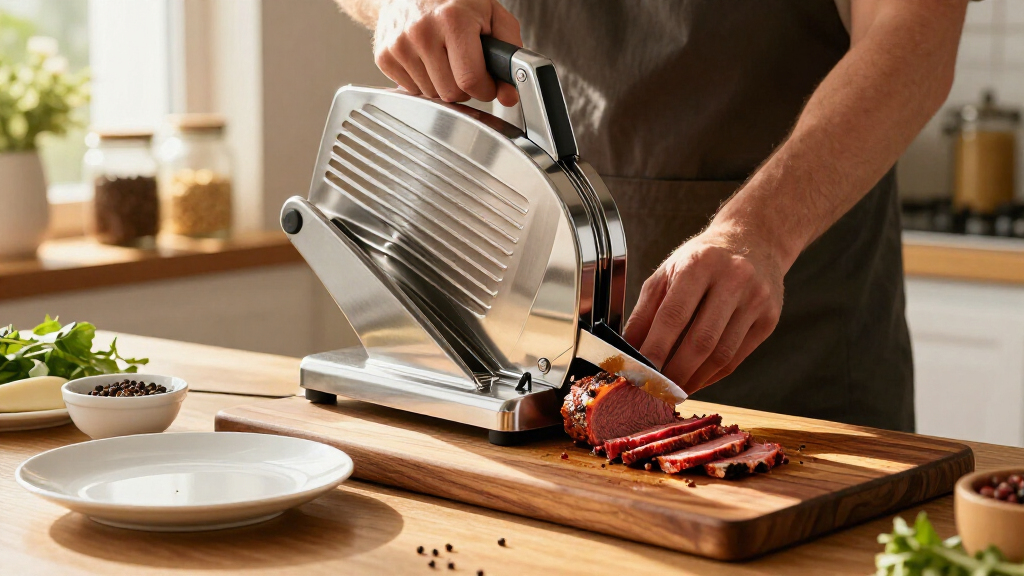
How We Picked
My ranking logic for this roundup centers on what actually matters when a commercial-style slicer lives in a home kitchen: blade size and material, motor type and sustained power, thickness range, cleaning practicality, and footprint. I weighted blade size heavily because it directly determines what you can slice without pre-cutting — a 12-inch blade handles a full brisket while a 7.5-inch blade demands prep work. I also prioritized removable blades and disassembly, since cleaning friction is the number one reason home slicers end up unused in a cabinet.
Power was judged on torque and consistency rather than the wattage number on the box, and I factored in build weight because a light slicer walking across the counter mid-cut is a genuine safety issue. Models that earned higher spots combine commercial-grade cutting capacity with home-realistic ergonomics — suction feet, blade guards, and reasonable storage profiles. Budget picks ranked lower not because they perform poorly, but because they demand compromises in capacity and durability that buyers should understand before purchasing.
| commercial meat slicer for home | Blade Material |
|---|---|
| Meat Slicer Machine for Home | — |
| Borlebbi 200W Electric Meat Sl | — |
| VEVOR 8.6" Electric Deli Meat | SUS420 stainless steel |
| OSTBA Meat Slicer with Two 8.7 | — |
| TUDALLK Commercial Meat Slicer | Chromium-plated carbon steel |
| Techwood Electric Meat Slicer | Stainless steel |
| ROVUN 8.7-Inch Electric Meat S | Chromium-plated steel |
| 10-inch Commercial Meat Slicer | Chromium-plated steel |
| BESWOOD 10-Inch Electric Deli | Chromium-plated steel |
| KWS 10-Inch Electric Meat Slic | — |
| Holdwell S SY-250A 240W Electr | — |
| CUSIMAX Electric Meat Slicer w | — |
| VEVOR 12-Inch Commercial Elect | Carbon steel |
| VEVOR Commercial Meat Slicer | Chromium-plated 45# carbon steel |
| VEVOR Commercial Meat Slicer | Carbon steel |
Factors to Consider When Choosing Commercial Meat Slicer For Home
Before picking a slicer from this lineup, it helps to understand the category’s core tradeoffs. A commercial meat slicer for home use is a bigger commitment — in money, counter space, and cleaning effort — than most kitchen gadgets, and the right choice depends on how often you will actually use it.Blade Size: The Decision That Shapes Everything Else
Blade diameter is the most consequential spec in this category, and it is the one first-time buyers most often get wrong. A 7.5-inch blade limits you to food that fits within a roughly 4-inch vertical opening — fine for salami, cheese blocks, and small roasts, frustrating for wide bread loaves or large brisket flats. 10-inch blades hit the sweet spot for most home cooks, handling the majority of deli and charcuterie tasks in a single pass. 12-inch models are genuinely commercial territory; unless you regularly slice large cuts or process game meat, the extra capacity mostly translates into extra weight and counter dominance. A common mistake is buying the biggest blade available and then discovering the machine is too heavy to move for cleaning — think honestly about your typical portion sizes before sizing up.
Motor Power and Torque: Why Watts Can Mislead
Wattage comparisons across this category are trickier than they appear because DC and AC motors behave differently. A 200W DC motor, like the one in the OSTBA, delivers high torque at low speed and often outperforms a comparable AC motor on dense cheese or semi-frozen meat. AC motors in the 240W–340W range, common on the commercial-style VEVOR and KWS units, sustain longer sessions without heat buildup, which matters if you slice in bulk for meal prep or hunting season. The telltale sign of an underpowered motor is blade slowdown under load — the blade visibly decelerates, the cut tears instead of slicing, and the motor strains. If you plan to slice hard cheeses or anything firmer than deli meat, prioritize torque reputation and gear-driven designs over the headline wattage number.
Cleaning and Blade Removability: The Real Dealbreaker
The uncomfortable truth about home meat slicers is that cleaning effort decides whether the machine gets used or abandoned. Every slicing session ends with meat residue on the blade, the guard, the carriage, and the thickness plate — and it all needs washing within hours to stay food-safe. Models with fully removable blades and detachable carriages cut cleaning from a 20-minute chore to a 5-minute rinse. Fixed-blade commercial units are built for restaurant staff who clean them daily as part of a routine; in a home kitchen, that friction compounds. Also check whether replacement blades are available and affordable, because even quality blades dull after a year or two of regular use, and a dull blade is both a safety hazard and a performance killer.
Thickness Range and Precision
Thickness adjustment separates the useful slicers from the toys. Most home cooks need a range from paper-thin (under 1mm) for prosciutto up to 12–15mm for thick sandwich cuts, and the quality of the adjustment mechanism matters as much as the range itself. Look for a calibrated dial that holds its setting under load — cheap slicers drift mid-session, producing uneven slices that ruin presentation and cook unevenly. The CUSIMAX’s 1–20mm range is the widest in this lineup, useful if you want one machine for deli meat, vegetables, and bread. Keep in mind that maximum thickness claims of 13mm+ only matter if the motor can push through food at that setting without bogging down; on underpowered machines, the wide range is more marketing than capability.
Footprint, Weight, and Stability
A commercial-style slicer weighs anywhere from 10 to 50 pounds, and that weight is a feature, not a flaw — heavier machines do not walk across the counter mid-cut. Lighter budget models compensate with suction feet, which work on smooth surfaces but fail on textured stone or wood. Measure your counter and your storage before buying, because a 12-inch commercial unit occupies the footprint of a stand mixer and then some. If you plan to store the slicer in a cabinet between uses, weight becomes a real cost: a 40-pound machine that needs two hands to lift will discourage casual use. The honest question is whether you slice weekly (leave it out) or monthly (buy lighter and smaller, accepting capacity limits).
Safety Features That Actually Matter
A meat slicer is one of the sharpest tools that will ever live in your kitchen, and safety design varies widely between price tiers. Non-negotiable features include a blade guard that covers the edge when not in use, an intermittent-on switch or timer rather than a simple toggle, and a carriage grip that keeps your hand well clear of the blade path. Commercial models add last-cut protection, which advances the final slice without your fingers nearing the edge. Never operate any slicer with the blade exposed while loading food, and unplug before cleaning — most slicer injuries happen during washing, not slicing. If a model lacks a blade guard entirely, treat that as a disqualifier regardless of price.
Frequently Asked Questions
Can a commercial meat slicer handle frozen meat at home?
Only the larger commercial-grade models in this roundup — the 10-inch and 12-inch VEVOR units, the KWS, and the BESWOOD — are built to handle frozen or semi-frozen meat, and even then, partially thawed cuts perform far better than rock-hard frozen ones. Full-frozen meat dulls blades quickly, strains motors, and produces ragged cuts regardless of the machine’s rating. The practical approach is to let meat soften just enough that a knife tip can pierce it, then slice — you get cleaner cuts and dramatically less blade wear. The smaller 7.5-inch home models like the Borlebbi and the generic 200W units should be restricted to fully thawed food; forcing frozen cuts through them risks motor burnout and blade damage that is not covered by warranty.
Is a 200W home slicer enough, or do I need a 300W+ commercial motor?
For occasional deli meat, cheese, and vegetable slicing, a quality 200W DC motor like the OSTBA’s is genuinely sufficient — DC motors deliver strong low-speed torque and handle dense foods without the slowdown you might expect from the wattage number. Where the higher-wattage commercial motors earn their keep is sustained bulk work: slicing 10+ pounds for a party, processing a hunting harvest, or running through hard cheeses back to back. AC commercial motors also dissipate heat better over long sessions, while small motors can overheat and require cooldown breaks. If your typical session is under 15 minutes, save the money; if you slice in bulk monthly or more, the commercial motor is worth it.
How much should I expect a home-use commercial slicer to weigh, and does it matter?
Weight in this category ranges from around 10 pounds for compact home models to over 40 pounds for 10- and 12-inch commercial units, and the number matters more than most buyers realize. Heaviness translates directly into stability under load — a heavy slicer stays planted while you push a dense roast through the blade, while a light one can shift or tip, which is both dangerous and produces uneven cuts. The tradeoff is storage: a 40-pound machine is staying on your counter permanently, because nobody hauls it out of a cabinet for a week’s worth of sandwich meat. Decide based on your honesty about frequency — daily and weekly slicers should be heavy and left out; monthly slicers should be light enough to retrieve without dread.
Do I really need a removable blade, or is that just a convenience feature?
Removable blades are closer to a hygiene requirement than a luxury. A fixed blade means cleaning the sharpened edge in place, scrubbing around the guard and motor housing with the blade still attached — slow, awkward, and the most common context for slicer injuries. Removable blades can go straight into washing, get fully dried to prevent corrosion on the cutting edge, and be inspected for nicks and dulling. Models like the Borlebbi, OSTBA, and CUSIMAX include a second blade, typically a serrated one for bread, which effectively doubles your machine’s range. If you will slice more than once or twice a month, I would treat removability as a hard requirement; fixed-blade commercial units make sense only for dedicated processing days followed by a full teardown clean.
What is the realistic difference between the 7.5-inch, 10-inch, and 12-inch blade sizes?
The differences are bigger than three inches suggests. A 7.5-inch blade suits small-diameter foods — salami logs, cheese wedges, small roasts — but wide bread loaves and large cuts must be trimmed down first, adding prep time. A 10-inch blade handles most full-size deli tasks in one pass and is why models like the BESWOOD and KWS sit at the top of this lineup; it is the size where commercial capability meets home practicality. A 12-inch blade, like the largest VEVOR’s, opens the door to whole briskets, large game roasts, and genuinely professional output, but the machine becomes a permanent counter fixture. My honest guidance: 7.5 inches for occasional sandwich slicing, 10 inches for serious home charcuterie, 12 inches only if you process large cuts regularly.
Conclusion
Narrowing 15 slicers down to one decision comes back to how you cook. For the best overall pick, the BESWOOD 10-Inch Deli Slicer balances commercial cutting capacity, sturdy build, and manageable home ergonomics better than anything else in this lineup. The KWS 10-Inch with its 320W motor is the best premium choice for bulk processors and hunters who need sustained power without stepping up to a 12-inch footprint. For best value, the OSTBA with its torquey 200W DC motor and dual removable blades delivers most of the performance at a friendlier price — and it doubles as the best pick for beginners thanks to its simple, forgiving operation and easy cleaning. If maximum capacity is the priority, the VEVOR 12-Inch is the best for large cuts and heavy-duty use, while the compact Borlebbi 200W wins as the best for small kitchens and occasional use. Match the machine to your slicing frequency, not your ambitions, and any of these will outperform anything sold as a budget deli slicer.
NFL season / tailgating Picks
team gear
As an affiliate, we earn on qualifying purchases.