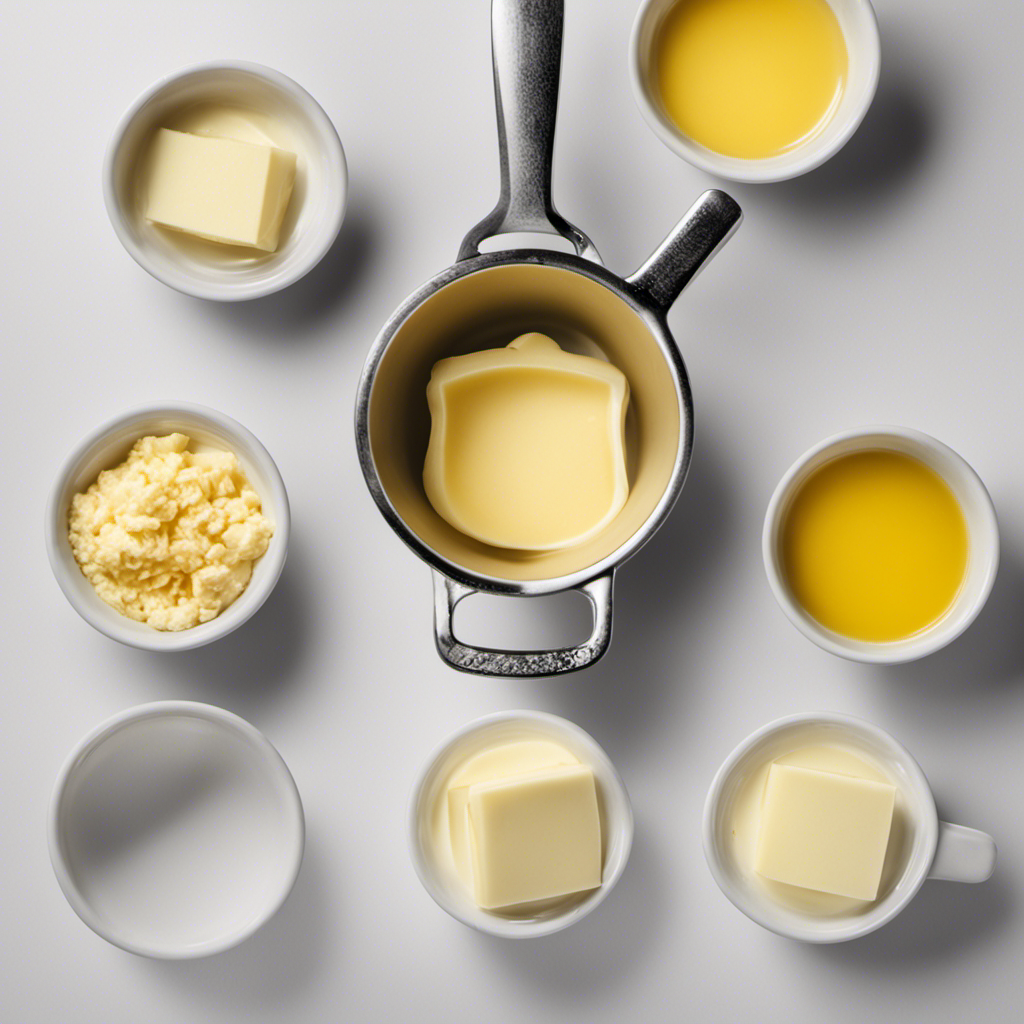
I’ve often found myself pondering over the quantity of tablespoons of butter equal to one cup. This query has frequented my thoughts numerous times, especially when I’m engaged in baking or cooking activities.
Well, I finally decided to dive into the world of butter measurements and figure it out once and for all. In this article, I’ll break down the conversion ratio, teach you how to measure butter in tablespoons, and show you how to calculate butter in cups.
Get ready to become a butter measurement expert!
Key Takeaways
- There are 16 tablespoons in one cup of butter.
- 1/2 cup of butter is equivalent to 8 tablespoons.
- 4 tablespoons of butter is equivalent to 1/4 cup.
- Measuring butter accurately is crucial for successful baking and cooking.
Understanding the Conversion Ratio
To understand the conversion ratio, it’s important to know how many tablespoons are in a cup of butter. Converting butter measurements can be confusing, but once you understand the basic ratios, it becomes much easier.
In the case of butter, there are 16 tablespoons in one cup. This is a common measurement used in many recipes. Knowing this conversion ratio is essential when you need to adjust your butter measurements.
For example, if a recipe calls for 1/2 cup of butter, you can easily calculate that it is equivalent to 8 tablespoons. Similarly, if a recipe asks for 4 tablespoons of butter, you can quickly determine that it is equivalent to 1/4 cup.
Understanding these common butter measurements will help you accurately follow recipes and achieve the desired results.
Measuring Butter in Tablespoons
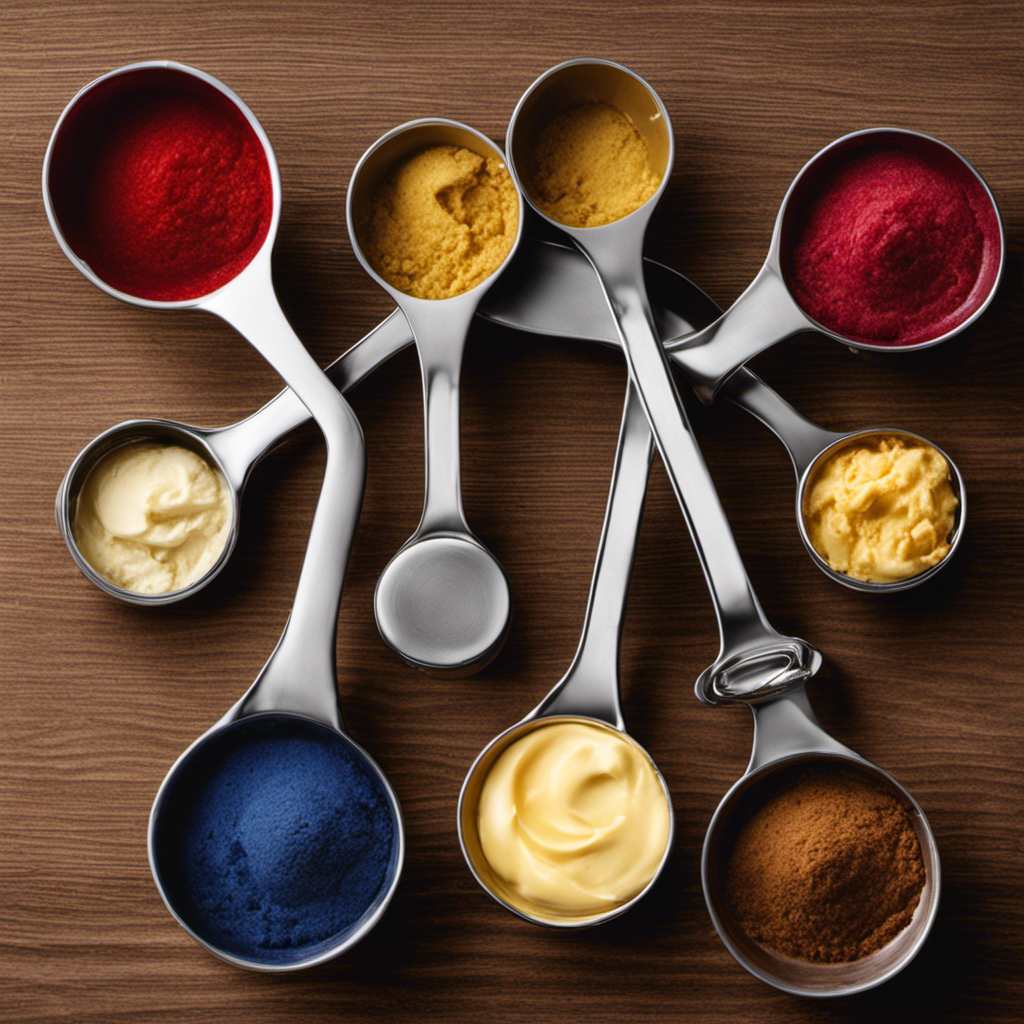
You can easily measure butter in tablespoons by simply dividing a cup into smaller portions. Here’s how:
-
Understand the conversion: In a standard cup of butter, there are 16 tablespoons.
-
Check the packaging: Different butter packaging sizes may vary, so always refer to the label for accurate measurements.
-
Use a measuring spoon: Scoop the butter using a tablespoon and level it off for precise measurements.
-
Multiply as needed: If you need more than a cup, multiply the number of tablespoons by the desired quantity.
Measuring butter in grams can be useful for more precise recipes. To convert tablespoons to grams, refer to a conversion chart or use an online calculator.
Now that you know how to measure butter in tablespoons, let’s move on to calculating butter in cups.
Calculating Butter in Cups
When measuring butter in larger quantities, it can be helpful to calculate it in cups rather than tablespoons.
When converting butter measurements to cups, it is important to know the weight of the butter in grams. For accurate results, it is recommended to use a kitchen scale.
To convert grams to ounces, simply divide the weight in grams by 28.35. Once you have the weight in ounces, you can then convert it to cups.
One cup of butter is equal to 8 ounces or 226 grams. So, if you have 113 grams of butter, it would be half a cup or 4 ounces.
Converting Butter Measurements
Converting butter measurements can be made easier by knowing the weight in grams and using a kitchen scale for accuracy. Here are some steps to help you convert butter measurements to grams:
-
Determine the equivalent measurement: Butter is often measured in tablespoons, cups, or grams. To convert, you need to know the equivalent amounts. For example, 1 cup of butter is equal to 227 grams.
-
Use a kitchen scale: To ensure precision, use a kitchen scale to measure the exact weight of the butter. Place your container on the scale, tare it, and then add the butter until you reach the desired weight in grams.
-
Adjust the recipe: Once you have the weight in grams, you can adjust your recipe accordingly. Use the converted measurement to ensure accurate results.
-
Keep a conversion chart handy: It’s always helpful to have a butter measurement conversion chart nearby for quick reference.
Tips for Accurate Butter Measurements
One tip for accurate butter measurements is to use a kitchen scale for precise results. Measuring butter accurately is essential for successful baking and cooking.
Common butter measurement mistakes include using a measuring cup to measure solid butter and relying on volume measurements instead of weight.
A kitchen scale allows you to measure the exact weight of butter needed for a recipe, eliminating the guesswork. To use a kitchen scale, place a bowl or container on the scale and press the tare button to zero it out. Then, add the desired amount of butter until the scale reads the correct weight.
This method ensures that you are using the exact amount of butter required, resulting in better and more consistent culinary outcomes.
Frequently Asked Questions
Can I Substitute Margarine for Butter in a Recipe?
Yes, you can substitute margarine for butter in a recipe. However, it’s important to note that there are some differences between the two. Margarine has a higher water content and a slightly different flavor, which may impact the texture and taste of your baked goods.
How Do I Measure Melted Butter?
Measuring melted butter accurately can be tricky. To convert tablespoons to cups for melted butter, remember that 1 cup is equal to 16 tablespoons. Use a measuring cup or scale for precise measurements.
Is It Possible to Use a Kitchen Scale to Measure Butter?
Yes, it is possible to use a kitchen scale to measure butter. By converting the weight to tablespoons using a reliable conversion chart, you can accurately measure the amount needed for your recipe.
Can I Use Oil Instead of Butter in a Recipe?
Using oil instead of butter in recipes has pros and cons. Olive oil adds flavor and health benefits, while vegetable oil is more neutral. Consider the recipe’s requirements and your preferences before making the substitution.
Are There Any Alternatives to Using Butter in Baking?
There are several alternatives to butter in baking, such as vegan substitutes like coconut oil, applesauce, or mashed bananas. These can be used in equal amounts as a replacement in most recipes.
Conclusion
In conclusion, understanding the conversion ratio is crucial when measuring butter in tablespoons or cups. By knowing that there are 16 tablespoons in a cup, you can easily calculate the amount of butter needed for your recipe.
Converting butter measurements can be tricky, but with practice, it becomes second nature. Remember to use precise measurements for accurate results.
As the old adage goes, ‘measure twice, cut once,’ ensuring you have the right amount of butter is key to a successful dish.